FFCE

Now Hiring: Are you a driven and motivated 1st Line Food Technologist?

FFCE

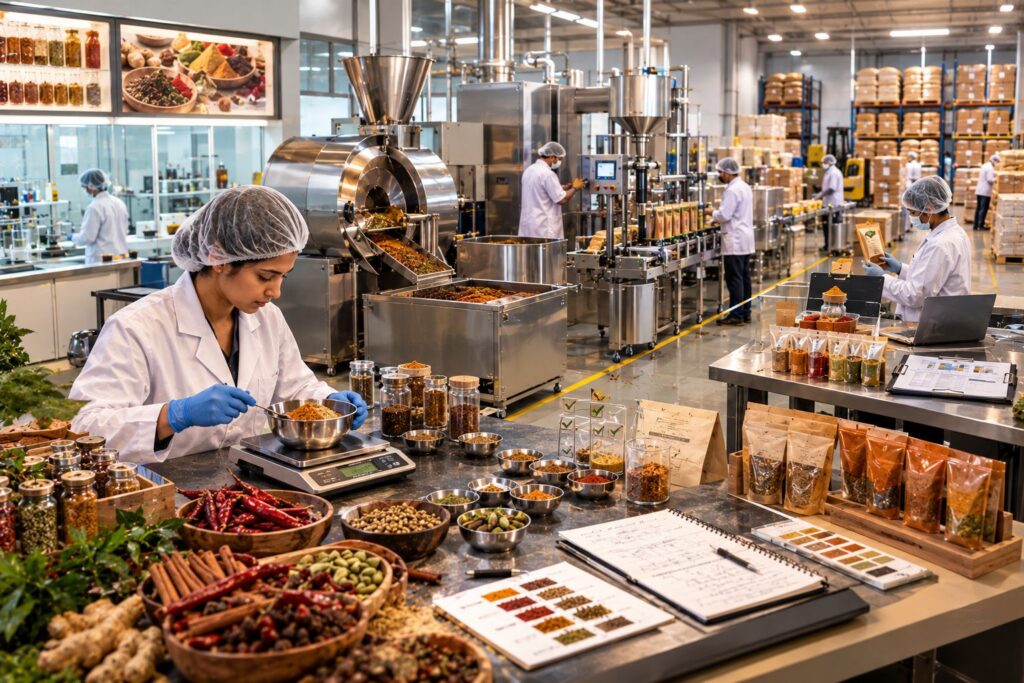
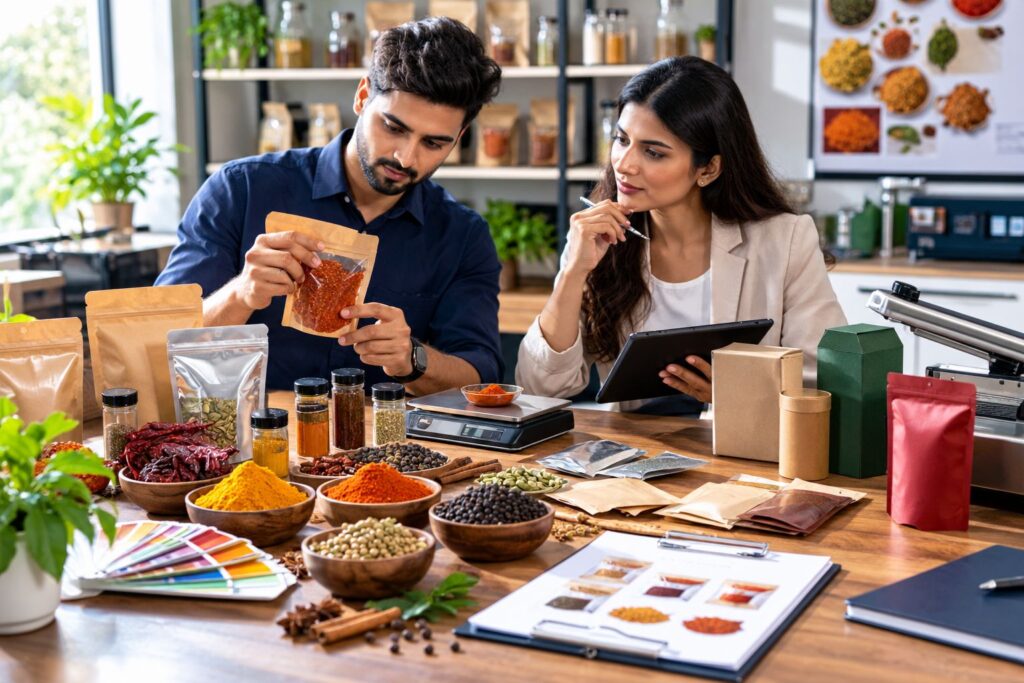
Food consultant guiding spice packaging design and production for a commercial spice business
FFCE

How a Food Consultant Helps You Choose the Right Packaging for Spices

Choosing the appropriate spice packaging requires careful consideration of market objectives, product sensitivity, and FSSAI compliance. This is where a food consultant comes in. They make sure packaging maintains freshness, improves shelf appeal, keeps the food product intact, and complements your brand strategy in close collaboration with a food technologist. The secret to a profitable spice business is this expert-led strategy. Products developed 0 + Years experience 0 + Countries served 0 + Clients served 0 + Introduction In India, classical ingredients and genuine recipes would never suffice for a spice brand. It must be rightly packaged to preserve aroma, maintain shelf stability, comply with regulations, and attain aesthetic shelf appeal. There, a food consultant or the food technologist would fit perfectly. Such consultants would assist you in facing the spice packaging difficulties with a mixture of market knowledge and technical skills. Why Packaging Matters in the Spice Business Spices are delicate substances prone to environmental damages caused by moisture, light, oxygen, and temperature. If bad spice packaging is used, it can lose its aroma, flavor can be degraded, clumping can take place or contamination via microorganism growth can occur. Proper spice packaging increases the commercial shelf-life of the spices and augments consumer trust and satisfaction of all regulatory provisions. Spice Packaging is the first interaction with the customer; it should therefore speak quality, hygiene, and authenticity. Role of a Food Consultant in Packaging Strategy Whether you’re targeting local kirana shops, supermarkets, or exports, a qualified food consultant can offer extensive industry experience in determining what spices work best for your business objectives. A food consultant assist in the following ways: 1. Understanding Product Sensitivity Every spice has its specific reactions. For instance, salt easily attracts moisture, while turmeric is sensitive to light. A food consultant defines the spice blends used together with the food technologists and suggests suitable containers like PET jars, glass bottles, or pouches with several layers. 2. Recommending Packaging Materials A food consultant advises on choice among: PET or HDPE jars: Best for powdered spices which need great barrier protection. Glass bottles: Setting premium appeal with non-reactiveness to gourmet-type spice blends. Metalized pouches: With minimum weight and cost as the best option for refills. Zip-lock laminates: Great for resealing convenience by consumers. 3. FSSAI and Labelling Compliance In India, food product packaging comes under the jurisdiction of the FSSAI. Food Consultant helps your spice packaging to carry mandatory declarations for net weight, batch number, date of packaging, best before date, nutritional value, and allergen information. They may even help you organize the different elements of label design as per font sizes and positioning laid down under law. 4. Sustainability and Consumer Appeal With such growing consumer awareness, many brands continue towards sustainable spice packaging. The food technologist, along with your food consultant, would then recommend using biodegradable, recyclable, or reusable materials for packaging consistent with an eco-conscious brand image. They further recommend packaging shapes, colors, and closures that enhance shelf visibility and serve ease of use. 5. Evaluating Storage and Supply Chain Needs Your spice packaging must endure the transport conditions of humidity, temperature, pressure from stacking, and others, especially if your intention is exporting or distributing to various parts of India. A food consultant evaluates storage, transit, and warehousing conditions before suggesting the type of packaging and thickness thereof. 6. Testing and Validation Upon choosing the packaging, the food consultant will liaise with the testing laboratories to enliven good scientific barrier tests, leak tests, shelf-stability tests, and migration tests. These scientific tests, often controlled by a food technologist, forestall any recalls but, basically, secure the product. Conclusion The selection of appropriate spice packaging requires individualized assessment instead of using standardized methods. Food consultants and food technologists bring major value because they combine technical knowledge with brand positioning expertise. Their professional knowledge provides genuine business value through compliance assurance, freshness maintenance, enhanced consumer appeal and storage durability. The early involvement of experts benefits businesses by reducing expenses while shortening timelines and building trust when entering local or international markets. Frequently Asked Questions What information should be required on spice packaging in India?Product name, list of ingredients, the FSSAI license number, net weight, MRP, batch code, packaging and best-before dates as well as manufacturer information are the required on spice package. Do I need different packaging for domestic and export markets?Yes. A food consultant will work with you to modify your spice packaging according to the import regulations and climatic conditions and consumer tastes of the destination country while a food technologist provides technical compliance support. What are the most cost-effective packaging options for spices?Flexible pouches combined with zip-lock laminates provide affordable scalable packaging solutions and a food consultant can help select the best cost-effective compliant packaging option for your spice brand. What impact does packaging have on FSSAI compliance?The FSSAI requires tamper-proof sealing, material safety, and unambiguous labeling. To avoid fines, a food consultant makes sure your spice packaging complies with all legal and labeling requirements. How can packaging help my spice brand get more attention in the market? Strategic spice packaging design together with functional aspects enhances product visibility on shelves and creates better user convenience and builds consumer confidence. A food consultant will work with you to match your packaging design with your brand objectives.
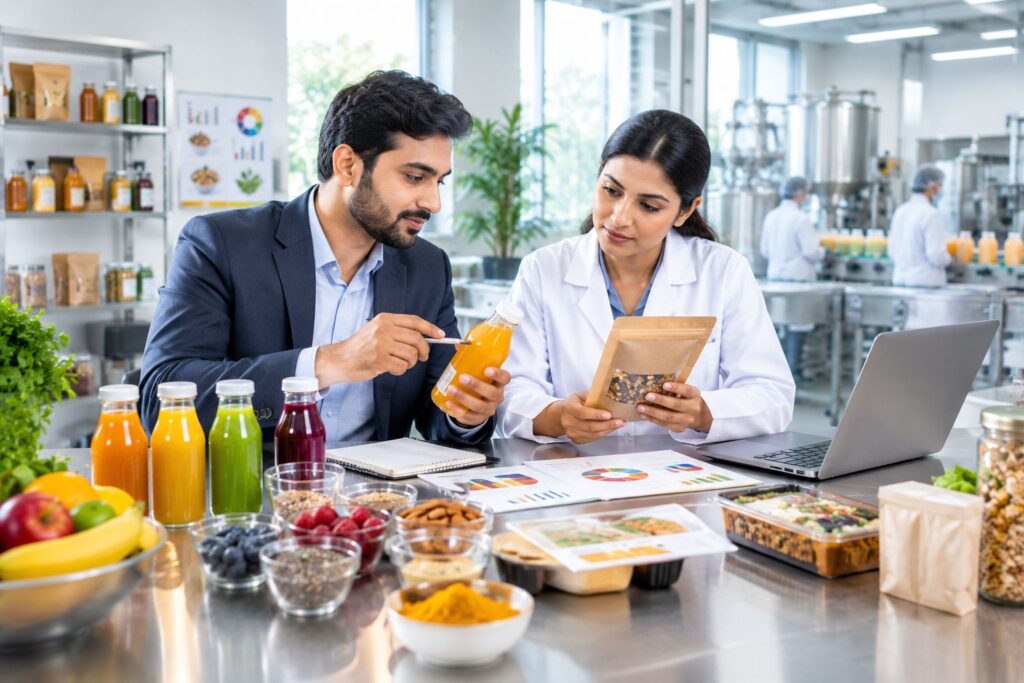
Beverage consultants in India working on drink formulation and product development
FFCE

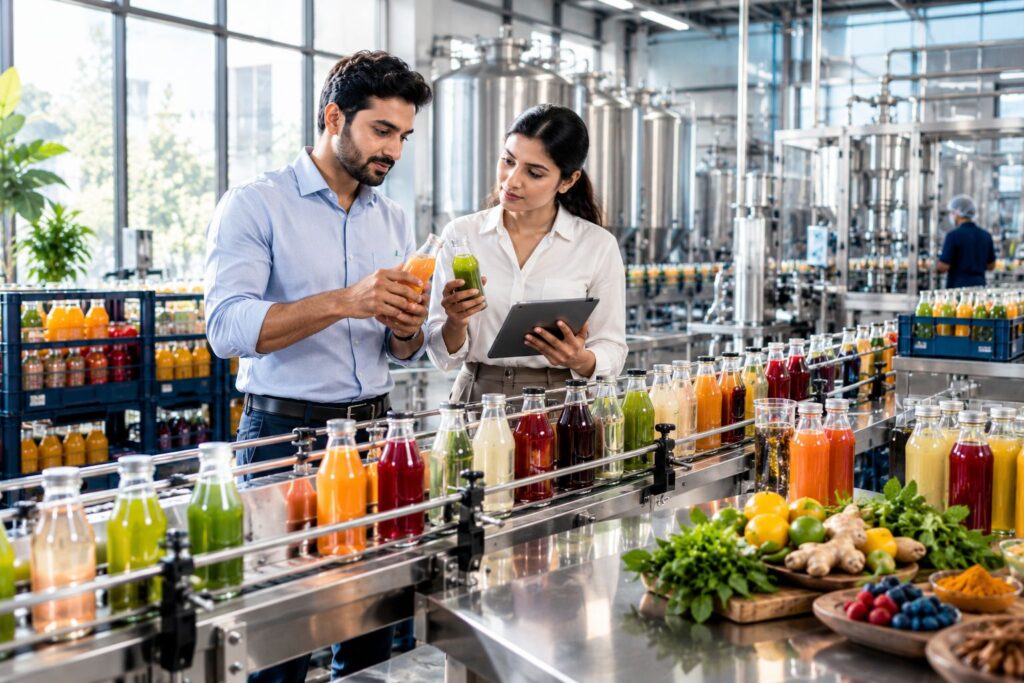
Beverage Consultants in India: The Secret Behind Every Successful Drink Brand

The Indian beverage market is thriving and booming, whether it is refreshing health drinks or indulgent energy drinks, there is innovation everywhere. It is important to know that behind every successful functional beverage brand there is a team of talented professionals and experts who take the idea of your product to market. The professionals are called Beverage Consultants in India, the true secret to creativity, compliance, and commercial success in the beverage market. What Is a Beverage Consultant and Why You Need One A Beverage Consultant works with you to take an idea around your beverage and develop a completed product that is a viable drink option. They assist brands throughout every step in the process, from drink concept and formulation, all the way to beverage production and marketing. They help formulate recipes, while helping to analyse market trends and the cost of ingredients, source the high-quality ingredients, develop FSSAI compliance, food safety and quality standards, label regulations, and keep a focus on quality. Beverage Business Consultant is an effective partner who helps you turn your dream into a profitable and scalable beverage brand. Products developed 0 + Years experience 0 + Countries served 0 + Clients served 0 + How Beverage Consultants Help with Product Development Beverage consultants are an essential part of building successful drinks. Beverage consultants can develop new product concepts, build a balanced formulation, source the best ingredients, develop prototypes, and taste test to complete flavour stability. They also ensure FSSAI appropriate compliance and develop quality standards. All beverage consultants have commercial research and development experience and market knowledge. Beverage consultants in India can turn beverage ideas into commercially ready consumer-approved products. Beverage Business Consulting: From Concept to Market A Beverage Business Consultant can help turn your drink concept into a successful beverage brand. They will assist you at every stage – market research, brand development, factory build, product packaging, marketing and distribution. And, with their strategic support, you will make informed decisions based on data, ensuring there is a reason for your beverage to stand out in a competitive market in India. Beverage Formulation Trends in India The beverage market of India is transforming at a rapid pace. Present-day beverage buyers select the drinks that are health-friendly, more open, and eco-friendly. The trends in the beverage industry are functional drinks; plant-based drinks; clean label, low-sugar drinks; and new uses of indigenous ingredients like turmeric and amla. With the help of Beverage Consultants in India, the brands are bringing forth these trends in the form of innovative products that are fit for the market. How to Choose a Beverage Consultant for Your Brand The corresponding Beverage Consultant can change the fate of your brand significantly.  You want someone with solid experience, strong research and development and formulation expertise, and a thorough understanding of FSSAI and other standards around the world. A good Food consultant is one who can provide a comprehensive service from concept to launch backed by client success stories. Engaging with the right Beverage Business Consultant in India allows your beverage brand to be successful, stand out from the crowd, and be compliant. Frequently Asked Questions What is beverage formulation and why is it important? Beverage formulation is a very essential function of the food and drink industry that reflects the most creative part of the process. It guarantees the same quality throughout, safe use, and pleasing the customers’ palates all of which are very important for the beverage to be successful. Can beverage consultants help with factory setup or manufacturing?Sure! A lot of Beverage Consultants in India offer total support services which include laying out the factory, optimizing the whole production process, and selecting the right suppliers. What are the top beverage trends in India right now? Plant-based beverages, functional beverages, low/sugar-free products, and beverages featuring traditional Indian ingredients and herbal plants like turmeric and tulsi are among the trends right now. How much does a beverage consultant charge in India?Consult fees will depend on the nature and size of the project. For small size projects, a consultant may charge around 50,000 Rupees, and full-scale beverage development could easily be more than several lakhs. How do beverage consultants ensure product quality and safety?The consultants follow a clear research and development process, conduct stability and microbiological testing, and ensure all ingredients and processes are being followed or aligned with industry standards and regulatory affairs.

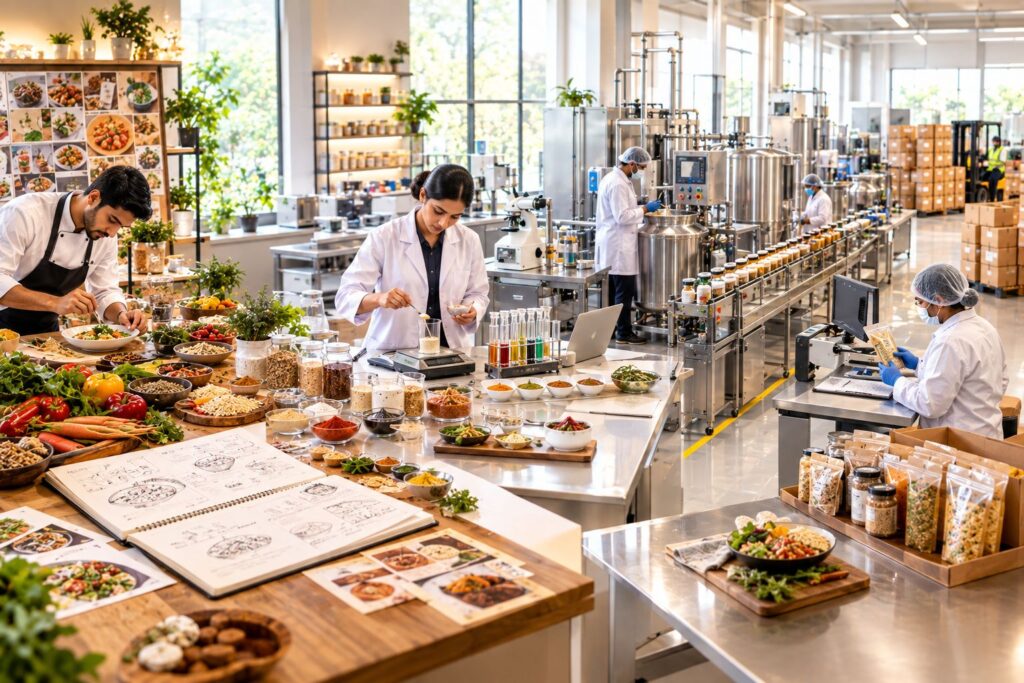
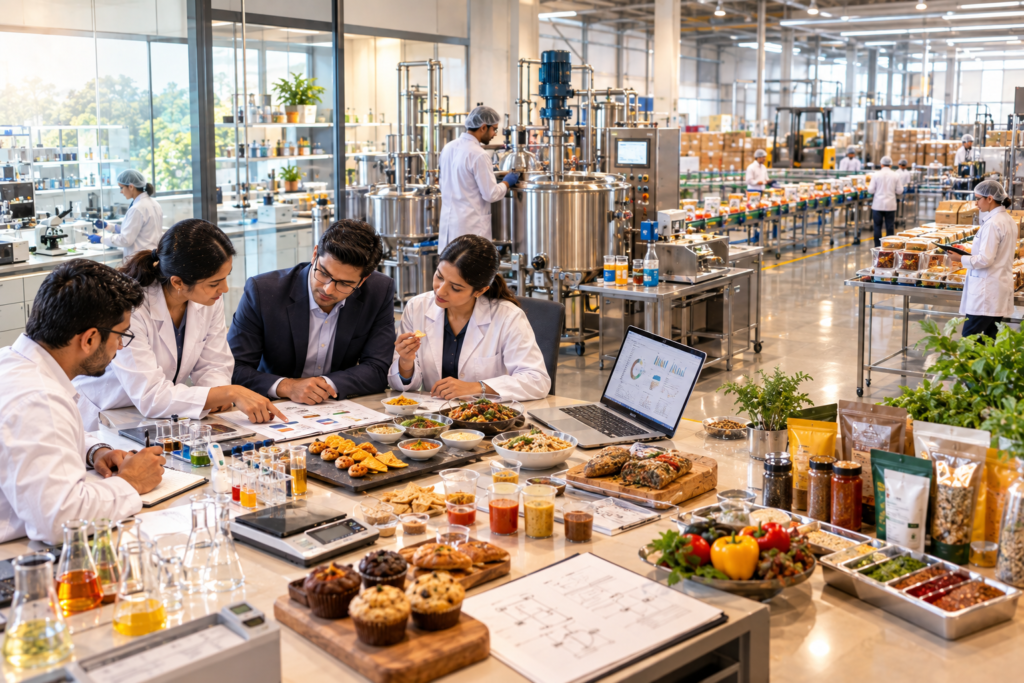
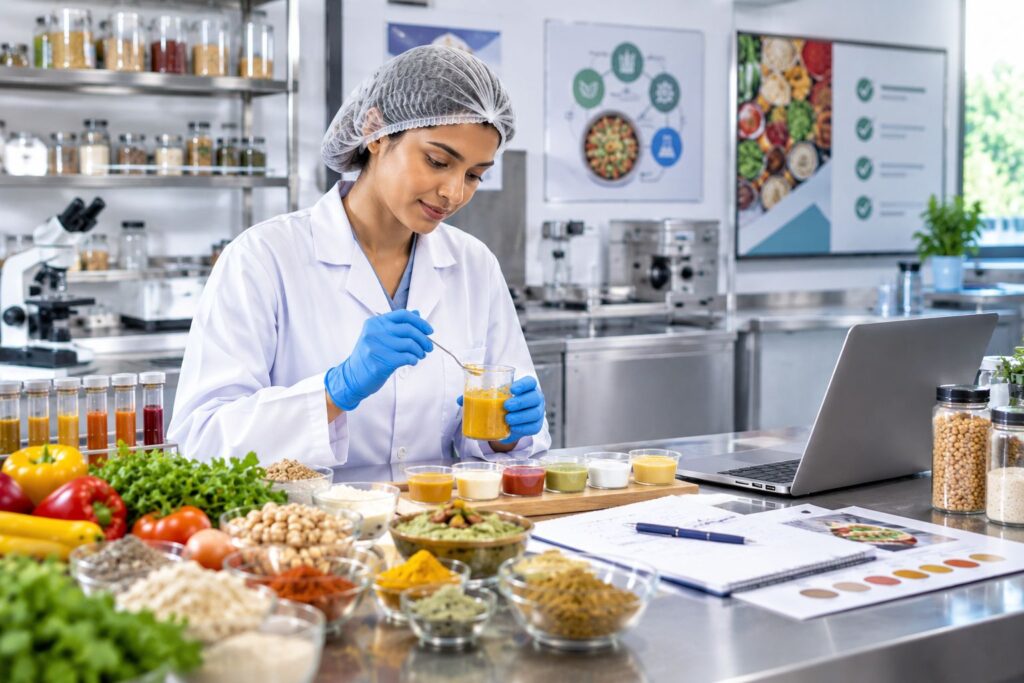
Food product recipe formulation and development with ingredient selection and testing
FFCE

Inside Product Recipe Formulation and Food Recipe Development in India

In the current food industry environment, the development of a successful food product involves more than just a  combination of ingredients. Product recipe formulation in India is both a science and an art, relying on creativity, technical knowledge, and market insight. In addition, food recipe development in India ensures that the product is safe for consumption, produced to a known standard, and positively regarded by consumers. Let’s delve into how the food recipe development industry operates and the array of professions supporting this entire industry. Products developed 0 + Years experience 0 + Countries served 0 + Clients served 0 + Why Spice Recipe Formulation Matters for Every Brand Recipe​‍​‌‍​‍‌​‍​‌‍​‍‌ development is essentially the science and art of creating food products by using exact ingredients, textures, Flavors, and ensuring that the product is stable for a certain period. In contrast to home cooking, commercial formulations in India ensure that each batch is consistent, that the products meet FSSAI specifications, that costs are kept under control while the quality is not compromised, and that new food products are made for both global and local ​‍​‌‍​‍‌​‍​‌‍​‍‌tastes. The Role of Food Technologists in Product Development An​‍​‌‍​‍‌​‍​‌‍​‍‌ India-based food technologist like the Frontline Food Consultants and Engineers (FFCE) is the main point to product development, utilizing knowledge in chemistry, microbiology, and food engineering to make real the products that stem from the ideas. They also take care of ingredient selection for safety and cost-effectiveness, standardize recipes for consistent flavor and texture, guarantee quality via shelf-life and safety tests, and develop small-batch recipes into large production, thus ensuring that new products become successful in the ​‍​‌‍​‍‌​‍​‌‍​‍‌market. From Lab to Market: The Journey of a New Food Product The​‍​‌‍​‍‌​‍​‌‍​‍‌ progression of a fresh food product in India starts with concept ideation, a phase where ideas are created based on market research. After that, recipe formulation takes place, whereby the experimenting with ingredients, the textures, and the Flavors is done. Also, prototype testing is carried out with the help of sensory evaluations and stability checks. The next steps are pilot production to scale the recipe for small batches, regulatory approval to get FSSAI compliance, and, eventually, the market launch with distribution, promotion, and consumer feedback. The organized flow of this process guarantees that products are in line with what consumers expect and that they comply with Indian ​‍​‌‍​‍‌​‍​‌‍​‍‌regulations. Tips for Successful Food Recipe Development in India To build a successful recipe for India, first, you need to know what tastes are preferred in different regions to make your recipe very local, secondly to be accurate in the amounts of ingredients used by everybody and lastly to think of shelf life of the product—this is crucial for packed items only. Working together with food technologists and consultants will make your recipes even better and trial with actual users will give you the most reliable feedback. If you go through these steps your recipe will have a much higher chance of becoming a market success. Frequently Asked Questions What are the distinct features of recipe formulation and product development? The former is the process of making and finishing the exact recipe, and the latter concerns the whole process from idea generation, and experimenting, to starting and marketing the product. Do food technologists handle recipe standardization?For sure. Standardization makes it possible that the recipe generates the same taste, texture, and quality for all the batches that are produced, no matter the size of the production. How long does it take to develop a food recipe?It is largely based on the complexity of the recipe and can take a few weeks or up to several months, this time range also includes the trials, testing, and regulatory checks. What types of businesses need recipe formulation?The professional recipe formulation service is a great advantage for restaurants, food startups, packaged food brands, catering services, and even small home-based food businesses. How can I get my recipe manufactured in India? Working with a contract manufacturer or a food production facility is an option for you. A food consultant can take you through the stages of recipe adaptation, compliance, and scaling for mass ​‍​‌‍​‍‌​‍​‌‍​‍‌production.

Spice recipe formulation and manufacturing factory setup in India
FFCE

The Complete Guide to Spice Recipe Formulation and Factory Setup in India

The spice industry in India is one of the most varied and vibrant contributors of the food industry. Whether it is the rich and indulgent garam masalas or unique regional blends, developing a spice brand may not be just about passion. It is all about precise spice recipe development in India and a well laid out spice factory setup in India. You will find directions on everything from recipe development to setting up your manufacturing unit, covered within this guide. Products developed 0 + Years experience 0 + Countries served 0 + Clients served 0 + Why Spice Recipe Formulation Matters for Every Brand A spice company’s brand identity, aromatic and taste qualities, is as vital as recipe specification. In India, spice recipe development is critical to every spice business’ success. If a recipe is developed well, the spice business has unique spice blends in several varieties that can help attract a customer’s attention amid spice competition. A well-developed recipe can lead to consistency of flavour in each packet. The recipe must meet FSSAI and other food safety standards. The ingredient ratios must be optimally developed to reduce to waste and profitably. If the recipe is lacking, strong marketing will only get a company so far. Step-by-Step Process of Developing Spice Recipes Developing a spice blend entails more than just blending ingredients.  The following approach should be used: Market Research Investigate the spice mixes in the market; where does your blend fit into what is available, and any regional or ethnic preferences. Select Ingredients Focus on sourcing whole, unground, high quality raw spices; taste, aroma, and shelf stability is key. Developing Trial Recipes Play with various ratios and combinations to develop a certain flavour profile. Testing Perform sensory tests with focus groups or small-scale production batches using the recipes you have developed Standardization Be sure to document recipes by volumes or weights so they can be replicated in larger scale production. Package & Test Storage Conditions Be sure that the recipe works as intended during storage conditions. Consider working with a food consultant in India; they can speed up the process and assure you are using a local expert in product recipe formulation in India. Legal & Licensing Requirements for Spice Factory Setup To legally operate a spice processing plant in India, it is important to follow some fundamental regulations which includes FSSAI registration for food-related businesses, GST registration for manufacturing and retailing, and a factory license under the Factories Act. In addition to registration and licensing, a trade license is required by a local municipal authority. There are other certifications like ISO or HACCP that are not required but are beneficial for quality and building consumer faith in your product. Meeting these legal obligations will not only enable your business to operate legally, but will keep you from potential shutdowns, and more importantly fines and penalties. How a Food Consultant Helps in Setting Up a Spice Unit In India, a legal and licensing compliance is necessary to set up a spice manufacturing company. The bare minimum requirements are FSSAI registration for any food business, GST registration for the manufacture and sale of goods, Factory licenses under the Factories Act, and Trade licenses from the local Municipal authority. It is also suggested that ISO or HACCP certification can be obtained but it is not a legal requirement. Compliance with laws in India secures you a legal business and prevents you from paying fines or getting shut down. Common Mistakes to Avoid When Starting a Spice Business A spice business is certainly a good business, but there are mistakes that can have a direct impact on your success. Avoid any unauthorized actions; a new businessperson’s typical behaviour is to skip some market study, use unproven materials, fail to temper conditions, produce differently, and not design or disguise your products. Once you remove these impediments, you will be able to ensure flavour consistency, obtain certification for health and safety, operate within the law, and innately attract the market, hence increasing the odds of success of spices business in India. Frequently Asked Questions What is the cost to establish a spice factory in India?The cost will depend on the size of the operation, machinery, type of property you are located on, and obligations to respond to governmental regulation and licensure. For small-scale unit the minimum investment could be anywhere between ₹10-20 lakh and larger spice based manufacturing units may require ₹50 lakh in an initial investment. What are the licenses required for a spice manufacturing unit?There are a few licenses that are required to operate most spice-based manufacturing units that include FSSAI licensure, GST registration, Factory License, and trade license for your business. There are optional certifications as well, which may be recommended, survey ISO or HACCP certifications. Can a food consultant assist in developing spice blends? Yes, a food consultant can design, test, and standardize a spice blend to a certain degree of accuracy, with assurance that the blends you put together will be similar, in response to requirements to be legal, and/or meet the expectation of the consumer market. What makes a spice blend unique in the Indian market?Unique blends are not only flavored but also show the region’s authenticity and are innovatively packaged. What are some ways to maintain the integrity of spice formulations? Using the same ratios of ingredients, using the right storage conditions, quality testing, and standardized processing.  

Food and beverage consultant helping develop a food brand and beverage products
FFCE

How a Food & Beverage Business Consultant Can Turn Your Idea into a Profitable Brand

Launching a food or beverage business is exciting, but the process of getting it developed as a sellable grocery product can be daunting. There are recipes, pricing, packaging, sourcing, machinery, marketing, and all the licensing involved. One mistake can delay your launch or increase your expenses. This is why employing a Food Business Consultant in India is important. The right Food Business Consultant, or Beverage Business Consultant or some Beverage Consultants in India leads you organized, less risk and saves to develop a brand that can grow profitably. The entire process is made clearer by a consultant. They are aware of supply chains, consumer behavior, compliance regulations, and the Indian market. More significantly, they assist you in transforming an undeveloped concept into a feasible business plan and ultimately a successful product. Products developed 0 + Years experience 0 + Countries served 0 + Clients served 0 + What Does a Food Business Consultant Actually Do? A Food Business Consultant helps you through every level of building and growing a food brand. Their role often consists of: Market research to confirm demand Product development and recipe standardization Shelf life testing and food safety oversight Help with FSSAI licensing and all the necessary paperwork Sourcing of raw materials and equipment and vendors Costing, pricing and financial planning Packaging design and labelling help Marketing and sales planning support They maintain a broad view, but can remember and appreciate the small details that may not be given much thought or overlooked entirely. You don’t have to struggle or waste time figuring it out yourself, as you will have a clear roadmap to follow right from an idea to an actual launch. Food vs Beverage Consulting: What’s the Difference? While food and beverage are related fields, they are not the same. Food products are about ingredients that require a certain processing, stability and packaging. Beverages deal with things like pH levels, preservatives, carbonation, pasteurization, bottling and cold chain. Beverage Consultants in India service drink-based product categories like juices, kombucha, energy drinks, flavored milk, smoothies and functional beverages. They work with you to determine the correct formulation and packaging so the product is stable and tastes the same every batch. A Food Business Consultant is more focused on food categories such as snack foods, baked goods, ready-to-eat meals, sauces, dairy products and more. They will be focused on consistency of the recipe and shelf life and manufacturing. Which consultant you select depends on your category. Some consulting teams cover both, which is great if you may later expand. Why Hiring a Consultant Early Saves Time and Money A lot of entrepreneurs only bring in a consultant after they have problems with production, shelf life or question costing out. The benefits of bringing in a consultant earlier are: Planning is clear before any money is spent Any machinery selected is appropriate for your products You know the real cost of your products so margins stay healthy Your licensing and compliance are seamless You can get a product to market quicker with less rework You look like a polished brand from the start Having professional advice early also prevents costly mistakes. A small fix to ingredients or packaging can save you big bucks over time. Real-Life Examples of Business Transformation Through Consulting Throughout India, a number of small food and beverage companies, with the support of consultants, have had impressive growth trajectories. For instance, a homemade pickle company scaled into a national D2C brand following the standardization of recipes and shelf life. A juice shop became a bottled beverage line by engaging aforementioned experts to work on formulation and bottling. Finally, a cloud kitchen became a franchise opportunity after costs related to the menu and operational systems were aligned. These examples illustrate how expert consulting is more than just a responsive function for issue solving; it is an opportunity creator when you can’t see it for yourself. Frequently Asked Questions What does a food and beverage business consultant do?Development, licensing, branding, and marketing planning are some areas in which they support you so that your launch can be more organized and less stressful. Can a consultant assist in factory setup and launching the product?Certainly. They can help you with layout, equipment, sourcing and compliance before guiding you through the launch. How do I determine whether to hire a food consultant or beverage consultant? It is simple, your product type will dictate the selection. If your product is mainly solid foods, consider a food consultant. But if your product is mainly drinks with some processing, select a beverage consultant. What industries benefit most from food consultancy?Industries like packaged foods, beverages, cloud kitchens, bakeries, dairy, health foods, functional drinks, and ready-to-eat ​‍​‌‍​‍‌​‍​‌‍​‍‌brands are benefitted most. Is consulting an option for small-scale food and beverage startup business?Absolutely, consultants are an essential early investment for small businesses; they help you avoid mistakes, unnecessary expenses, and create a better brand from the very ​‍​‌‍​‍‌​‍​‌‍​‍‌beginning.

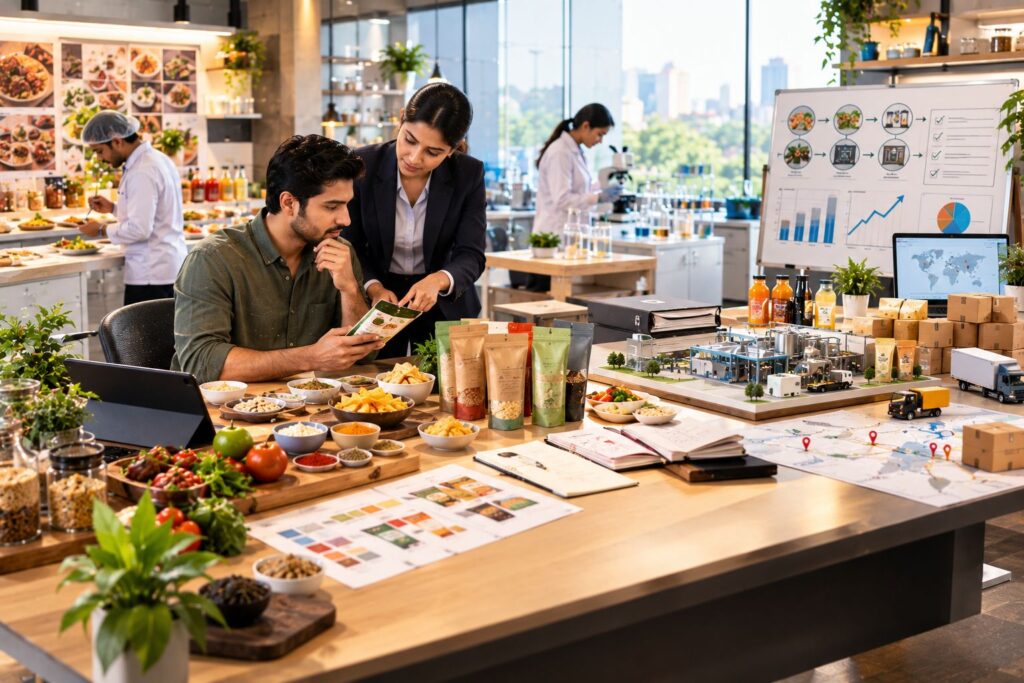
Professional food consultant helping food brands with product development and manufacturing
FFCE

Why Every Food Brand Needs a Professional Food Consultant in India

The food industry in India grows rapidly. From local cloud kitchens to large packaged food companies, all players need to differentiate themselves in a crowded market. Behind every successfully branded food experience there is usually an expert food consultant in India who has guided the journey. They connect the creative, compliance, and commercial success for brands that want to develop ideas into marketable products. Products developed 0 + Years experience 0 + Countries served 0 + Clients served 0 + What Does a Food Consultant Actually Do? A food consultant offers a professional consulting service at all stages of the development and operation of a food business. Their involvement can include product idea development through to identifying scale of production. If you are a startup looking to develop a new snack brand or an established restaurant wanting to build to the next stage, the food consultant will offer you advice on making effective business decisions. Some of their major responsibilities involve: Product innovation Supporting the process of new recipe creation, making good ingredient choices, and testing. Meeting regulations Guaranteeing that all FSSAI and packaging requirements are met. Product innovation Supporting the process of new recipe creation, making good ingredient choices, and testing. Meeting regulations Guaranteeing that all FSSAI and packaging requirements are met. Cost savings Assisting in lowering manufacturing expenditures while maintaining product ​‍​‌‍​‍‌​‍​‌‍​‍‌quality. Recorded processes Assisting in designing kitchen layout, production systems, and SOPs. Brand positioning Advising on flavor trends, packaging, and consumer interests. To put it simply, they bring together food science, business strategy, and market knowledge — that few entrepreneurs can do on their own. How Food Consultants Help Launch Successful Food Brands Starting a food brand isn’t only about having something delicious. You should consider your market strategy, quality of product, and your model in terms of scale – and that’s what food consultants do.   Each food consultant will do a feasibility study for you on new brands, outlining the opportunities and risks of investing in a concept. The next step is to develop your brand, value proposition, and product or brand; these experiences should be based on current trends, such as the ongoing trend toward clean label and plant-based products.   Food consultants will oversee all of your pilot run, shelf life, and quality validation before you land a distribution contract. Good consultants will also help guide restaurants or cloud kitchens make sure you’re following the best practices in menu engineering, sizing your portions correctly, choosing the right suppliers, and making sure your operation meets food safety standards. Essentially – Food consultants help assure that the business is built upon strong, sustainable practices. Top Benefits of Hiring a Food Consultant in India The Indian food system is complex and nuanced, requiring technical and market experience to navigate efficiently. Here are 5 primary benefits of using a food consultant: Industry Expertise: Consultants know the hottest trends, such as functional beverages and healthy snacking and assist brands to stay authentic. Clarifying Regulatory Compliance: An understanding of FSSAI and any other food safety laws, needs to be understood and followed. Food consultants help keep peace knowing your product is 100% legal. Fast-Track your Product Launch: Consultants have a structured process that will minimize timelines, and subsequently aid in bringing your product to market faster than if you were to do it alone. Cost-Savings: From buying lower-priced ingredients to increasing the efficiency of the production line, consultants help improve margins. Quality and Quality Stability: Consultants will help you set up systems in place to ensure your product consistency and quality are stable which builds trust. In summary, a food consultant in India helps turn your idea into a creation that is said to be legal and monetized. Key Areas a Food Consultant Can Transform in Your Business A qualified food consultant can provide valuable service in many aspects of your food business. The areas where a consultant can provide the most benefit are likely: Product Innovation developing novel recipes and product lines tailored for the Indian and international markets. Manufacturing Setup manufacturing floor plan layout, identifying and sourcing equipment, and staff training for smooth production. Food Safety Systems complete HACCP, ISO or FSSAI viable systems. Supply Chain Management Establishing more efficient sourcing and vendor arrangements for raw materials. Brand Strategy providing insight into brand positioning through packaging, labeling, and price points. Whether a packaged food company or quick service restaurant empire, these enhancements will positively affect your profitability and reputation. How to Choose the Right Food Consultant for Your Brand Your brand could be made or broken by your choice of food consultant. Seek out a candidate with a technical background and practical industry experience. The following should be taken into account when searching: 1. Experience and Knowledge: On the one hand, look into their past jobs and make sure they have experience with brands that are comparable to yours, for instance, ready-to-eat meals, dairy, beef, or snacks. 2. Portfolio and References — Past work and feedback from former clients is a very important; it provides you valuable insights. 3. Range of Services — An effective consultant offers both technical and business services ranging from R&D to branding. 4. Communication and Partnership — Engage someone who carefully listens and considers your vision and creates a strategic, meaningful execution plan. 5. Transparency with Fees — Request a written proposal that details consulting fees and proposed timelines prior to signing anything. Working with an honest and ethical food business consultant is often a long-term partnership. The right expert is much more than just a person who helps you launch; but one who helps the you build toward sustainable and long-term growth. Conclusion A knowledgeable consultant in food consultancy in India would guide your food concept into an operational business. Be it a new venture or to keep an established business in line with best practice, an investment in food consultancy helps avoid expensive mistakes, ensures compliance, and develops your brand, to which consumers will keep coming for its quality and reliability. Frequently Asked

Food recipe development process from initial concept to commercial-scale production
FFCE

Recipe Formulation Process for New Food Products: From Concept to Commercial Scale

The food industry continues to evolve with product formulations that present us with nutritional and health benefits. Food recipe development requires a comprehensive study on the ingredients used, interactions that occur and the available technologies for product development. Changing consumer preferences, realization of the importance of a balanced diet, and varying dietary pattens have contributed to the advancements in food industry. Developing the right recipe is important but translating the work from R&D to large-scale manufacturing requires an integrated approach. The first step prior to food formulation development is the evaluation of raw materials used, cost and identification of allergens. Transitioning from the lab to mass production requires formulas (relative percentages) more than recipes. This ensures scalability and consistency. Sticking to a formula helps in retaining the texture, mouthfeel and quality of the products irrespective of size. It is also important to analyze the product goals i.e. if the specific product is developed for fitness enthusiasts or kids’ health or for diabetic patients etc. This will help in choosing the right ingredients based on the nutrition, functionality and flavor. For instance, protein source can be chosen from dairy (whey) as well as from plant-based (chickpea, soy). Sweeteners can be from natural (honey, maple syrup, stevia, monk fruit etc.) or artificial (sucralose, aspartame) sources and the choice of binders (dates, oats, figs etc.) for desired applications. The next step is to pick the right texture (chewy/soft/crunchy), taste (savory, sweet, salty, bitter etc.) and calculate the nutritional content (proteins, calories, fiber, fat etc.). After the recipe formulation, it is important to check how long the product remains safe with the desirable quality. Shelf-life testing is conducted to evaluate its sensory appeal under controlled conditions (humidity, temperature, atmospheric pressure, light etc.). Any change in physical (color, texture, appearance), chemical (ingredients breakdown, presence of contaminants), sensory (alterations in texture, off-flavor) parameters are recorded during this stage. This test helps to determine any risks associated with degradation, proper storage conditions and stability. Another important aspect in the product roll out plan is to ensure that the formulated recipe matches the set regulatory standards and a food consultant will be able to shed light on this. Food safety certification is an important element in demonstrating compliance and indicates the company’s allegiance to preserving high safety standards. Food labelling regulations are practiced to keep customers informed of the contents of the package in addition to the date of expiry. Appealing package design also influences the purchase decision and spotting the right marketing domain to carry out trial runs will be highly beneficial. Acquiring customer feedback during the product launch will help to gather information on the product quality. The inputs will be useful in making amendments and fine-tuning the process during the development stage.

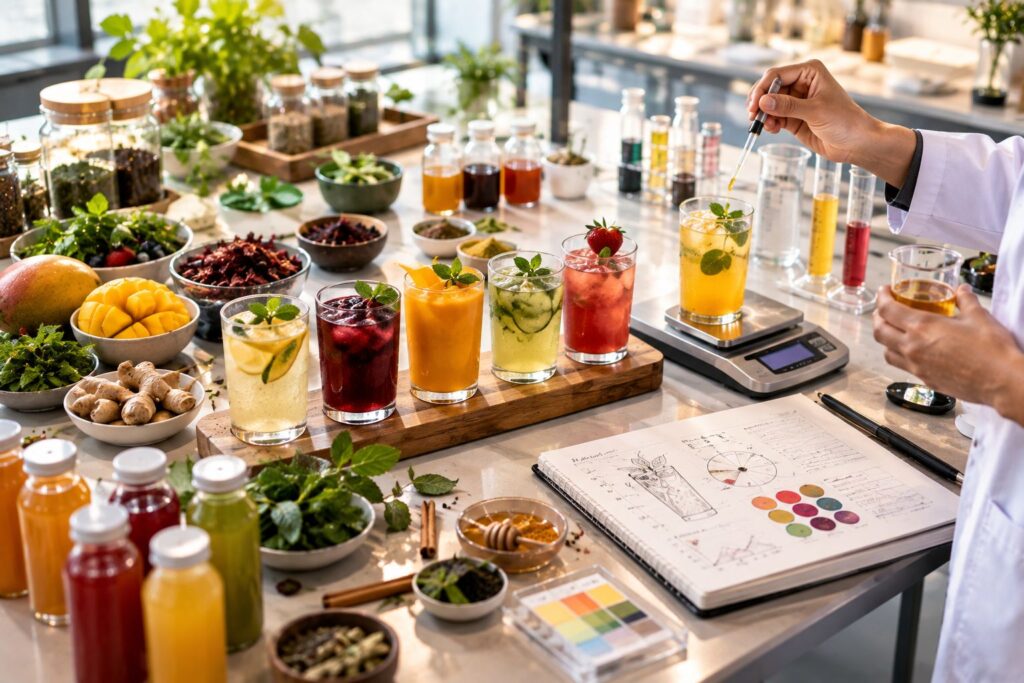
Beverage recipe formulation in India with ingredient selection, flavor development and product testing
FFCE

Beverage Recipe Formulation in India: Creating Stable, Scalable & Market-Ready Drinks

Beverage recipe formulation relies heavily on the choice of right ingredients, functionality, proportions of the constituents and the processes used to concoct a drink of desired standards. Hot drinks, soft drinks, milk drinks and alcoholic drinks are subsumed under the umbrella of beverages. The global beverage market reached to USD 1.92 trillion in 2025 and is expected to climb to USD 2.56 trillion by 2030. The India beverage market size amounted to USD 80.11 billion in 2025 and is projected to reach close to USD 154.67 billion by 2035. Innovation is important in beverage industry and this factor sets the product up for success. The burgeoning demand for beverages in India could be attributed to the rising urbanization, increasing disposable income, diverse consumer preferences, convenience and portability, focus on health-conscious selections and presence of several distribution channels. Also, these elements underpin the emerging beverage categories, thereby becoming a prerequisite of new product development. A beverage business consultant must therefore concentrate on picking out current trends, identifying target audience, and analyzing competitors. The first step in beverage recipe formulation is the selection and souring of ingredients appropriate for the texture, flavor, and nutritional benefits of the beverage. Some important things to take into consideration are identifying the kind of drink, branding and packaging required, conducting market research in order to develop an exotic beverage. Customers place more emphasis on taste and flavor and these influence their repurchase decision. Another important factor is the texture – smoothies, juices and fruit nectar have different effects on our tongues. A suitable texture (chewy/pulpy) will influence the flavor and taste of beverages. The appropriate choice of stabilizers and additives are useful in emulsion stability. The type of packaging also contributes to maintaining the brand image. For instance, aluminum cans have a better shelf life as those can be sterilized at high temperatures than plastic ones. Prior to running the product through the production line, communicating with a food consultant for a trial production run and conducting stability studies to check changes in flavors and discoloration would be highly beneficial. The ultimate goal therefore lies in manufacturing beverages at an affordable price with superior quality.  The beverage market in India offers ample opportunities for growth. The presence of a strong consumer base and changing consumers’ preferences fosters the beverage sector’s expansion. The Government of India lends support to investment, offers regulatory support and stimulates R&D activities in beverages. Promotion of healthy beverages, product diversification, strengthening supply chain management, adopting sustainable packaging methods and improving cold storage facilities will contribute to sustainable growth and enable a seamless transition from concept formulation to large-scale production.  

Food recipe development and formulation for commercial food production
FFCE

Food Recipes Development for Commercial Production: A Consultant-Led Approach

Food formulation is the process of developing or designing food products with added functionality and hence is a vital step in product development. A judicious selection of ingredients with appropriate use of technology, and production processes are of paramount importance as consumers prefer a final product based on the tangible and intangible benefits they offer. The food recipe development in India involves the consultants working in tandem with food technologists to harness their knowledge in optimizing the right formulation. This product ideation and strategy formation is then followed by product design and process development. The laboratory conditions differ from industrial production and so is necessary to exercise caution during scale-up by charting out process flow diagrams, suggesting the suitable machinery, formulating layout plants that match with FSSAI (Food Safety and Standards Authority of India) regulations and developing standard operation procedures. In order to navigate the complexities of food landscape, food consultants zero in on budgeting and cost analysis also.  Optimizing day-to-day operations will yield better productivity and enhance efficiency. Evaluation of quality and safety products using chemical and microbiological testing is also crucial in identifying the presence of contaminants and careful monitoring of important parameters (pH, temperature) ensures operational efficiency. There is a necessity in developing food products with longer shelf-lives and texture retention. Failure to do so will adversely impact the retailers and wholesalers. Therefore, careful assessments of ingredients and their interactions, temperature and pH sensitivities, contamination risks, water activity, packaging material and storage conditions are of utmost importance. Familiarizing with the food safety standards, labeling requirements, and complying with permits and licenses in commercial food production will enable to streamline the operations effectively. The consultants also advise on the design of a food pilot plant to replicate the full production before setting up a full-scale commercial facility. This provides an understanding of the existing inaccuracies, and helps in modifying those effectively. The final phase is the launching of product into market. A thorough study of market analysis and identifying consumer choices and current trends will help in achieving sustainable growth. Partnering with the right consultant will be invaluable for a manufacturer looking out for reducing costs, mastering supply chain management and fostering innovation. The acceptance or rejection of food products is strongly dependent upon sensory analysis. The panelists evaluate the properties (taste, flavor, appearance, texture, smell) through their senses and this analysis has been very beneficial in new product development. In addition to this, other factors such as health, emotions, nutritional and social aspects, environment, packaging material etc. sway consumers’ decisions in product preferences  

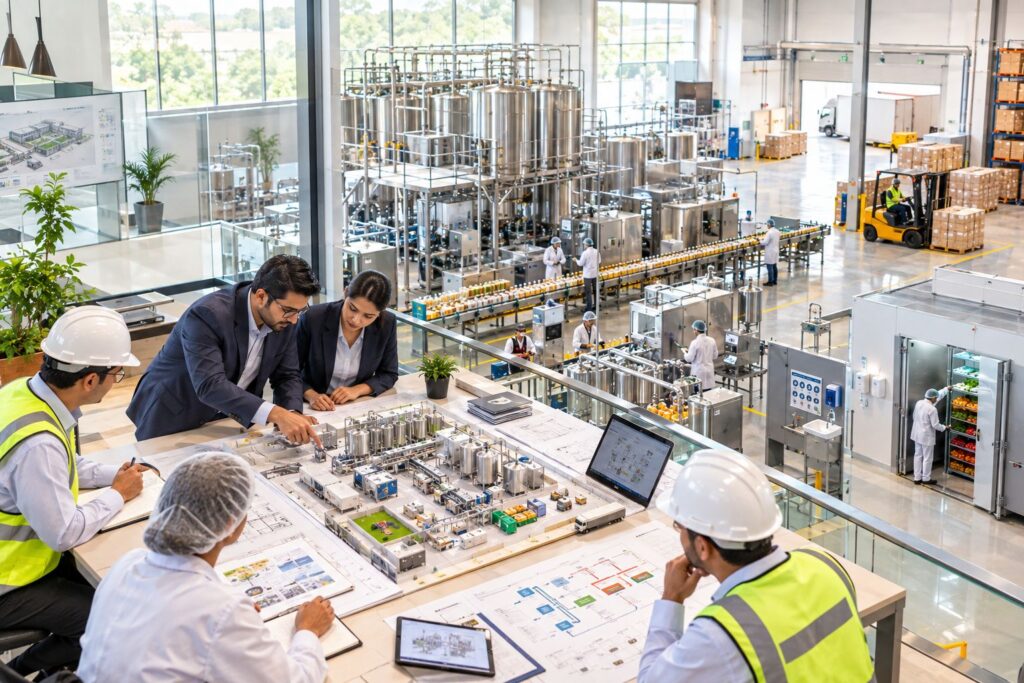
Food plant setup consultant planning a food manufacturing facility with production equipment
FFCE

Food Plant Setup Consultant Guide: Planning, Equipment Selection & Compliance

Food plant setup basically is an overall design of a manufacturing unit and includes several stages such as product identification for manufacture, feasibility study, design and economic appraisal, material procurement, installation of plant and commissioning. The design encompasses technical aspects, number of unit operations, market outlook, economic conditions etc. The primary role of a food plant setup consultant is to analyze the specific requirements of clients and develop a customized layout that offers operational efficiency. The first step to follow before establishing a food processing plant is to conduct in-depth market research. Identifying the current market trends in the industry, preferences of consumers and competitors in the field will provide insights into market dynamics. This is followed by developing a business plan. The business structure must be first established – sole proprietorship/partnership/private company etc. and then the business name must be registered with the Registrar of Companies. Choosing an appropriate location for plant construction is a vital step and this decision is dependent upon the proximity of the plant to raw material suppliers, accessibility to stock, distribution of the end product and labor availability. The regulatory requirements such as obtaining import export code, FSSAI (Food Safety and Standards Authority of India) license for food safety standards, GST registration for tax compliance, trade license for operating legally in the municipality, fire safety certificate and pollution control NOC (no objection certificate) for abiding by the fire safety regulations and meeting environmental laws of emissions, waste and pollution are required before setting up a food manufacturing business. The next step is to craft a business plan that includes enumerating the objectives of company, strategies for the operation and marketing of the enterprise, amount of capital required for the plant establishment, estimation of profit, revenues and cashflows, calculating the cost of labor, production, raw materials and overhead expenses. A written business plan indicating the financial requirements and available funding from investors and other financial institutions must be documented. Securing funding and acquiring licenses will enable the construction of manufacturing plant with provisions made for machinery, packaging material and storage facilities. There are stark differences between the food and non-food processing plants and these stem from their production methods. As the shelf life of foods is minimal and the quality is strongly influenced by several factors like pH, temperature, microbial contamination, water activity etc., product safety is of prime importance. Therefore, food plants are designed to offer high sanitation levels to prevent the possibility of contamination and product deterioration. Implementing quality control measures is an important in upholding consumer trust. Establishing hazard analysis and critical control points (HACCP) and standard operating procedures (SOPs) for processes will educate the staff on best practices and regulatory changes in the industry. Expanding business internationally will provide access to a larger consumer base, drive innovation and enable market diversification. It is therefore necessary to develop a marketing plan for product advertisements through online platforms, social media, and engaging in trade shows. Adhering to these steps and seeking assistance from a food consultant will help in overcoming the challenges related to a plant setup and achieving business goals.  

Scroll to Top

Your Trusted Food-Tech Partner Simplifying Solutions, Maximising Success

    Your idea is 100% protected by our Non Disclosure Agreement

    What is Refresh icon

    Your Trusted Food-Tech Partner Simplifying Solutions, Maximising Success

      Your idea is 100% protected by our Non Disclosure Agreement

      What is Refresh icon

      Your Trusted Food-Tech Partner Simplifying Solutions, Maximising Success

        Your idea is 100% protected by our Non Disclosure Agreement

        What is Refresh icon

        Powering your food business forward