FFCE

Now Hiring: Are you a driven and motivated 1st Line Food Technologist?

FFCE

Skyr Icelandic protein-rich yogurt gaining popularity in India
FFCE

The Icelandic yogurt – Skyr

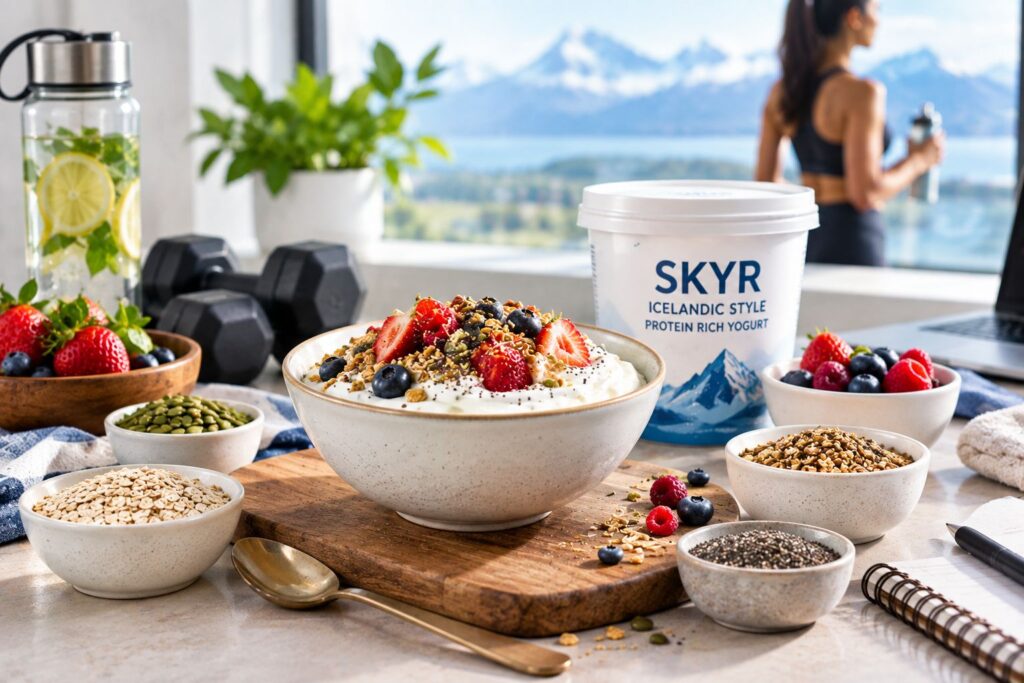
Protein rich foods have taken over the processed foods market, not only in India, but around the world. This has led to the development of proprietary alternatives, and has also paved a way to traditional protein formulations that have been used for centuries, from around the world. One such traditional product that has been used by the people of the north for centuries is the rich creamy yogurt, called skyr. What Exactly is Skyr? This type of yogurt substitution is made by combining a unique bacterial culture, namely the Streptococcus thermophilus Islandicus and Lactobacillus bulgaricus. It is said that the residents of Iceland use this unique culture to make yogurt which is very creamy, dense, and possesses a peculiar sour taste. Products developed 0 + Years experience 0 + Countries served 0 + Clients served 0 + What makes Skyr unique Skyr is a good source of protein, it contains 10-12g of protein per 100g Low fat: Traditionally made from skim milk Creamy texture: Achieved through straining away the whey; no cream is added In some traditional Icelandic recipes, a discrete culture known as the “Skyr culture” is passed down from generation to generation. These microflora aid in coagulating milk proteins and impart a characteristic tartness to Skyr by fermenting the lactose into lactic acid. After cultivation, the curd is settled very heavily in order to extract most of the whey, concentrating the protein and thickening the product naturally without the aid of gelatin or thickeners. A Glimpse into Skyr History Some ancestors called cheesy or headed by cheeses paid a visit a couple of centuries or even more ago to present in Iceland, as the settlers Norse arrived all up through the ninth century. It was an food that was rich in nutrients and was able to be preserved in cold weather, and that is why it was there in every household in Iceland for centuries. Making Skyr was an art passed down through generations, and Icelandic families kept their own starter cultures. Being a heritage product, commercial success only came into it once large companies like MS Iceland Dairies started industrially producing it in the late twentieth century. On the global scene, that has continued over the last decades. Some contributing factors to the recent surge in worldwide demand are: Global emphasis on protein-rich foods Growing demand for natural food products Increasing interest in Nordic nutrition and well-being Today, Skyr features quite prominently as the fancy dairy product with practical applications for being satiating and good for intestinal health and muscle recovery, hence making it available all over the U.S., the U.K., Germany, and quite a number of other countries including India. The place of Skyr in the Indian market In India, dairy products are divided more traditionally with yogurt dominating the market, but the recent trend for value-added dairy products such as Greek yogurt, probiotic drinks, and lately Skyr has caught on. Key Trends in India Fitness and health consciousness: Urban families and along with the younger working clientele have turned to high-protein food options, hence supporting the growth of Skyr. There is less of an issue of lactose intolerance due to fermentation. Expanding taste buds: Icelandic and international cuisines have been exposed to the Indian food landscape through travel and social media. Current Players in India One of the pioneers, Epigamia, sells a line of products based on Skyr that have flavors of Indian fruits. While not yet concentrating on Skyr, Amul and other dairy cooperatives are investigating value-added markets. Wellness speciality brands: Provide clean-label and artisanal Skyrs in big cities such as Delhi, Mumbai, and Bengaluru. Though brandy is young, the future looks brilliant. India can be a good place for the Skyr to penetrate, especially if the product is affordable with a local taste due to its strong dairy infrastructure and the health-conscious middle class. The Road Ahead At the nexus of tradition, indulgence, and nutrition, Skyr is still largely unknown. It provides Indian customers with: An alternative protein that is clean-label A healthier alternative to traditional dahi In India’s dairy market, which is worth over $100 billion, it has the potential to establish a devoted following with the correct product education, pricing plan, and culinary adaptation.
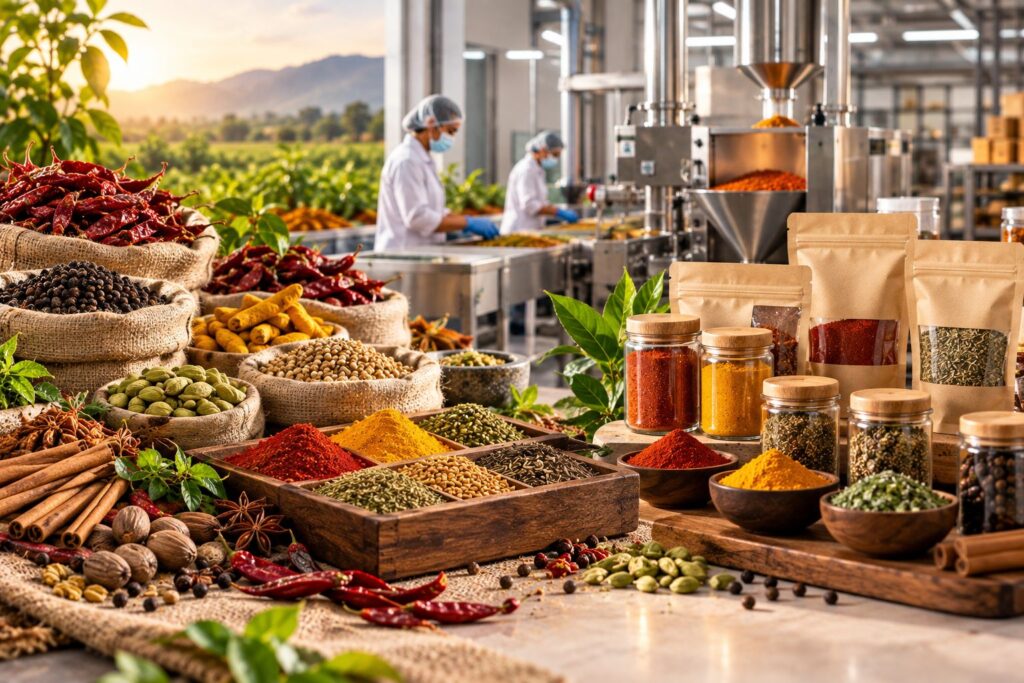
Spice manufacturing business in India with spices, processing equipment and packaging
FFCE

Starting a Spice Manufacturing Business in India: Expert Guide by Food Consultants

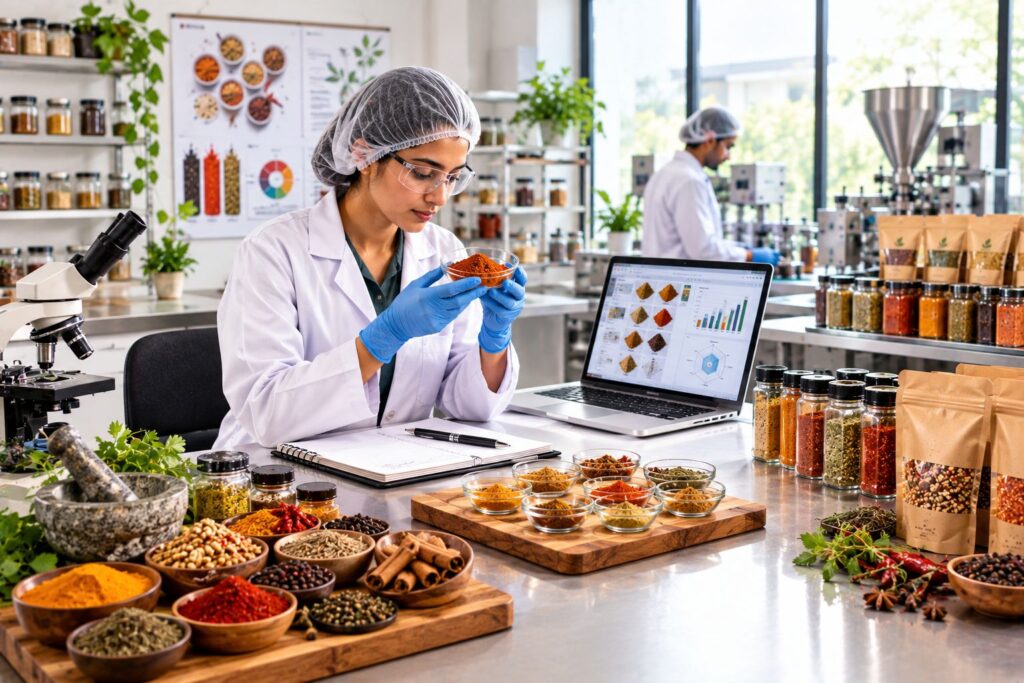
A spice manufacturing business in India is a great opportunity for emerging brands because there is growing demand for good quality and hygienic spices. Working with a food consultant can help you manage everything from spice processing and compliance, to branding and exports. This guide will start you off to building a successful business in the spice industry. Introduction India is a land of spices, and also is a long-time producer and consumer of spices. With the rising demand for authentic Indian spice around the world, pursuing a spice manufacturing business may be profitable. If you’re looking to start spice manufacturing, this comprehensive food consultant guide has all the information you need from the conceptual stage to processing, licensing, and food consultants. Products developed 0 + Years experience 0 + Countries served 0 + Clients served 0 + Understanding the Scope of Spice Processing in India Spice processing involves cleaning, roasting, grinding, blending, packaging and sometimes oil extraction of certain spices, like turmeric, chili, coriander, cumin, black pepper and more. India is the largest producer, consumer and exporter of spices; hence it is a good location for a spice unit. The spice manufacturing business can be developed on a small scale with relatively small investment or a large-scale business for export. The demand for hygienically processed, ready to use and attractively packaged spice powders is increasing, both domestically and abroad due to changes in lifestyle. Step-by-Step Guide to Start a Spice Manufacturing Business Market Research and Business Planning Start by identifying your customers you may be working with consumers (retail) or exporting your spices. Then conduct market research to understand what types of spices are in demand and how competitive they are in your area.Develop a business plan or at least a framework of ideal details, such as investment (cost) in equipment, projected profit margins who is your ideal consumer, how will you source raw materials, space and equipment needed to process spices, how you will market your business. An experienced food consultant can help you structure your plan so that you are realistic in your goals, are using proper market data and to help project ROI. Legal Compliance and Licensing Ensure the processing area is clean, sanitary, in compliance with FSSAI regulations so that you won’t have to face the issues of licensing and compliance later. FSSAI application (Food Safety and Standards Authority of India) Udyam/MSME application GST Registration Trade License Trademark Registration (for brand protection) Import Export Code (IEC), if planning to export. The help of a food consultant will certainly ensure that all statutory requirements get fulfilled. 3. Selecting the Location and Setting Up the Unit Choose a location that has good transport accessibility and existing facilities like electricity, water supply and labour. Depending on scale, the premises need to cover machinery for spice processing, storage, packing and administration. There are no large-scale investments needed equipment includes: Spice grinder Roaster (optional) Sieves and filters Packaging machines Weighing scales In terms of laws and compliance, there are some legal formalities to follow on starting a spice processing unit in India. 4. Sourcing Raw Materials and Processing Good raw materials are very important. Build a rapport with local farmers or spice traders to purchase fresh, organic spices. Always clean and dry the spices completely to maintain quality. Grinding and blending should be done with food safe machines to be consistent and safe. With the assistance of a food consultant you could create unique spice blends or masala mixes specifically designed around a region or specific health orientated customer needs. Recipe Formulation: Role of a Food Consultant Recipe development is an important element of starting a successful spice manufacturing business. The right food consultant can develop recipe blends that consistently provide the desired taste, while also being formulated to meet FSSAI guidelines for your targeted market. Whether you are developing traditional masalas or are developing modern blends for the health or organic consumer, the food consultant can ensure your recipes are safe for food consumption, shelf-stable and taste alike every time you formulate them. Also, having your own unique formulations can contribute to branding your spice products and differentiating them from competitors. Role of a Food Consultant in Spice Business Utilizing a food consultant can greatly simplify the process of establishing your spice manufacturing plant. Food consultants can provide support at every level, including: Feasibility studies and market research Plant layout and equipment selection Recipe formulations and product development Shelf-life testing and food safety Branding and packaging strategy Conclusion There are plenty of opportunities in India to start a spice manufacturing business, especially if you work with a food consultant. Everything from market research, regulations, product development, and customers is part of your responsibility, and building a sustainable and profitable business takes time. Your spice brand can thrive in India and the rest of the world, with appropriate planning, quality control, and the right advice. Whether you’re a new entrepreneur or an established player wanting to diversify, this food consultant guide outlines the fundamentals to start your journey toward spice processing. Frequently Asked Questions Is a food consultant able to assist in setting up a spice business? A food consultant can assist with a lot in formulating a business plan, plant layout, regulatory compliance, recipe and quality control development and marketing strategy. Which licenses do we need to obtain to initiate a spice manufacturing business in India?FSSAI registration, Udyam/MSME registration, GST registration, trade license, trademark registration (for branding), and Import-Export Code (IEC) when you set up your business for exporting. What is the amount of investment required for a small-scale spice processing unit? Investment is usually in a range of ₹5 to ₹15 lakhs for a small-scale unit depending on machinery, location and initial raw materials stocks. What role does a food consultant play in the manufacture of spices?Food consultants play an important role in quality assurance and hygiene, shelf -life testing, spice blends and development of value-added products. What can I do to ensure that my spices are of good quality for my business?Work

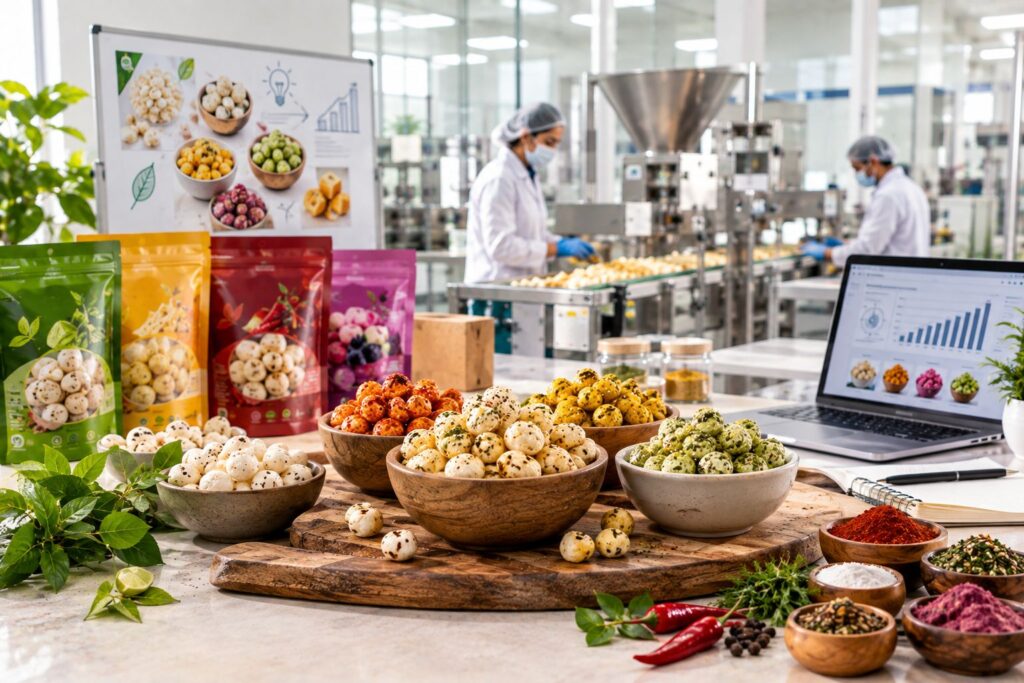
Flavoured makhana business setup with roasted fox nuts and seasoning
FFCE

Flavoured Makhana Business: The Role of a Food Consultant in Building a Profitable Snack Brand

Flavoured makhana is an Indian snack that’s gaining popularity as a leading healthy snack option worldwide, which has a huge profit margin and a low cost of materials. Steps to establish & set up a makhana processing unit includes planning, selecting the right machinery/equipment and developing a product recipe or formula. A food consultant can facilitate the success of your idea by providing direction on plant setup, product formulation and quality assurance, with the goal of establishing a branded, compliant and typical snack that can be marketed and grown in the future. Introduction The demand for healthier snacks is growing rapidly in India. Flavoured makhana (fox nuts) are now regarded as the healthiest wellness snack option. Entrepreneurs interested in food processing are now, more than ever, looking to experts to assist with starting their businesses painlessly. In this article, we will take you through the most important information regarding makhana processing, snack unit setup, recipes, and just how a food consultant for snack units will help make your idea a moneymaking opportunity. Products developed 0 + Years experience 0 + Countries served 0 + Clients served 0 + Why Flavoured Makhana? Makhana, or puffed lotus seeds (water lilly seeds), possesses a strong nutritional density with low-fat content. With increased attention to healthy eating, consumers are making their way to healthy snacks such as flavoured makhana that have no guilt associated with them. flavoured makhana is available in unique flavours such as peri-peri, masala tangy, cheese, and caramel, which leaves many opportunities when it comes to all recipe formulation. For potential food entrepreneurs, establishing a makhana processing unit is a great opportunity, for the following reasons: Cheap raw material High profit margins Increasing retail and exports Scalability potential Setting Up a Makhana Processing Unit: Step-by-Step 1. Evaluating Market Potential It is important to learn about market trends, customer preferences and competitors’ activities before starting a flavoured makhana unit. You also want to qualify who is your target market and what are you going to use as distribution channels: retail, online, etc., to establish your unit in the market. You could engage a food consultant to provide guidance in assessing demand, understanding price points, and helping you identify market gaps, so your business is built on a sound base of meaningful information. 2.Tools for Processing and Roasting It is advisable to invest in the main pieces of equipment, including: Roasting machines (either manual or automatic). Flavouring tumblers. Filling equipment. Oil spray and spice blender. A food consultant can help your snack unit select cost-effective and scale systems based on your budget and number of units. 3. Recipe Formulation and Flavour Development This is the business’s heart! You will be judged solely on whether you develop unique and exciting flavours. Food consultants specializing in snack units can work with you to: Create standard recipes. Manage flavour consistency. Optimize seasonings. Manage shelf-life stability. For example, a standardized recipe would simply be dry roasting the makhana in olive oil, seasoning with Himalayan pink salt, chili powder and garlic powder, and tumbling the seasonings evenly through the product. How a Food Consultant Adds Value A professional food consultant with experience, technical knowledge, and strategic direction brings a highly valuable resource to your snack units’ business. A consultant will minimize the errors you might make through trial and error, will save you time, and will increase the chances of succeeding early in the highly competitive food market. Here’s how they can help: Complete project planning and plant layout Cost/ROI analysis Machine and vendor recommendations Product trials and quality testing Training staff and developing SOPs Conclusion: Makhana – A Healthy Business Opportunity Flavoured makhana isn’t simply a trendy snack it’s a scalable and sustainable business model as well. If you have done your homework, have equipment, and access to a food consultant guide, you can start selling sensational (and trending) snack products in the booming health food segment which India is experiencing. If you are starting a local brand or exporting brands as well, if you are looking at good quality makhana processing and recipe formulation you will be ahead of the competition. Be sure not to overlook the importance of a food consultant for snack units they are your partner in making a product that is distinct in flavour, quality and safety compliance. Frequently Asked Questions What is makhana and why is it becoming a popular snack?Makhana, or fox nuts, or lotus seeds is a seed that is typically eaten as a snack in roasted or flavoured forms. Makhana is low in fat, gluten free, and fits in today’s eating patterns. So, supply and demand ultimately coincide with demand for healthier alternatives to traditional fried snack options. Is the makhana business profitable in India? In India, the makhana business can be profitable, but this is contingent on factors like sourcing of raw materials, manufacturing background, market demand and level of competition. The whole industry shows growth, with regards to makhana demand, although profitability will differ based on the business model, scale of business and implementation. What are the basic machines needed to begin a makhana unit? The main machines needed are a roasting machine (manual or automatic), a spice blender, an oil sprayer, a flavouring tumbler, filling/packing machine, etc. What kind of assistance does a food consultant provide for a makhana snack business? A food consultant helps with plant setup, recipe development, market analysis, vendor selection, quality control, shelf-life testing and staff training respectively. The food consultants will tackle many of the startup obstacles, allowing your company to start-up its company with lower risk and to ensure that you are compliant with laws and regulations. Can a food consultant help create recipes?  Of course. Food consultants create standardized innovative shelf stable flavour recipes for your target consumer and brand.  

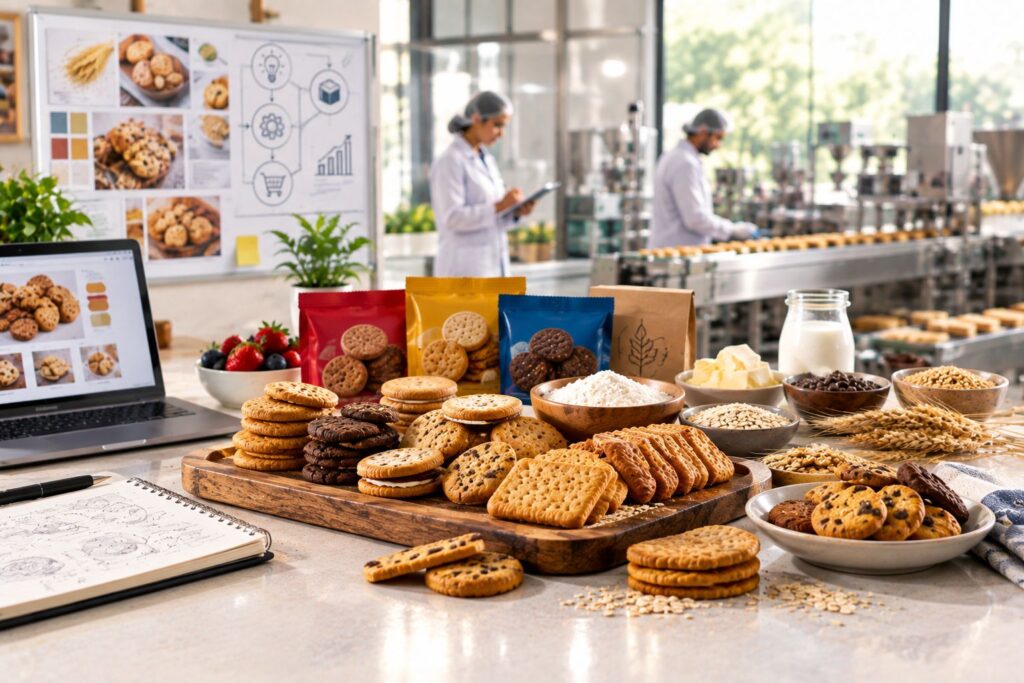
Biscuit brand manufacturing and packaging setup in India
FFCE

How to Launch Your Own Biscuit Brand in India with Help from a Food Consultant

If there’s to be the most sought after processed food to be named, it would definitely be the biscuits and cookies. This segment makes up most of the confectionery, baked, and gourmet bulk of the procesessed food market. In India, biscuit brand launch opportunities are significant, with the request for unique cookies (biscotti) and healthier baked products increases. A food consultant will help you in setting up the right bakery, to facilitate production streamline production and compliance with regulations, and combining that with a plan to build a strong brand to compete in the biscuit manufacturing industry. Introduction India is one of the largest markets for biscuits in the world, providing a huge opportunity for entrepreneurs looking to launch a food business. India’s tastes are changing and demanding healthier options, there is never a better time to launch a unique biscuit. There is infinite potential and profitability in biscuits but to succeed in this crowded market you must use your passion and professional assistance. This is where a food consultant and a proper bakery comes into place. Products developed 0 + Years experience 0 + Countries served 0 + Clients served 0 + Understand the Biscuit Market Before you dive into production, research the biscuit market trends. Decide on your niche are you going to develop healthier oat biscuits, premium cookies or economical glucose biscuits. Your product must fit with today’s consumers. This research will provide direction for your branding, packaging, pricing and marketing strategy. Collaborate with a Food Consultant Working with a skilled food consultant is life changing. They help with: Recipe development Shelf-life testing Nutritional profiling Legal compliance (like FSSAI licensing) Choosing equipment for your bakery set up Scaling your production Plan Your Bakery Setup The scale of your production unit will depend upon what scale of production you would like to start with. If you are making your products in-house, you should make sure your bakery setup qualifies. It’s important to make sure that your unit complies with hygiene and safety standards. A food consultant will be able to design your operation so that it runs most efficiently and in line with regulatory compliance. Another option is to use third-party biscuit manufacturing by contracting bakers many food startups go this route to limit their initial investment. Dough mixers and blenders Rotary or deck ovens Cutting and shaping machines Cooling racks and conveyors Packaging machines Branding and Packaging Visual impact and credibility are big factors in the biscuit sector. Partner with professionals to develop effective visuals with attractive, informative, and most importantly, sustainable packaging. The packaging must display the brand name, branding/logo, the ingredient list, the nutrition labels, the FSSAI license/small print, and messages that say something about your biscuit brand and company values. A food consultant also provides packaging and branding for food entrepreneurs. Sales and Marketing You can begin by selling direct online through your website or through a marketplace like Amazon, Big Basket or others. Retail sales with local Kirana stores and supermarkets are also essential.Apart from these, there has to be a strong presence on the quick commerce platforms as well. Exhibitions, sampling, and influencer promotions will also help your business grow. Frequently Asked Questions What is the budget for a biscuit manufacturing business in India? A small-scale business may take ₹5–10 lakhs capital, while a medium scale setup may be ₹20–50 lakhs based on how automated your production is and how much you are producing. Is it necessary to get an FSSAI license to sell biscuits in India?Yes, an FSSAI license is required for any food business to manufacture or sell food. Can I make biscuits from my house and sell them?Yes, many small businesses can start from their house, but if you’re making biscuits on a larger scale, you will need a professional bakery setup. Who is a food consultant? A food consultant is a consultant in recipe development, factory design, compliance, packaging, vendor selection so that everything within your food business operates smoothly and legally..

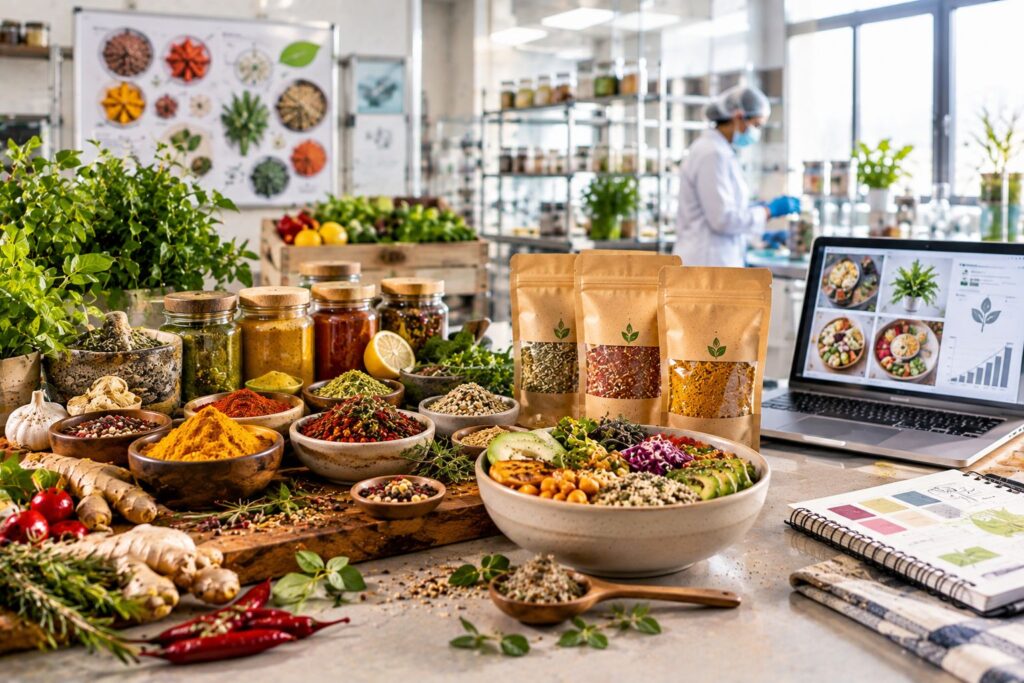
Seasoning trends 2025 featuring bold flavors, clean label ingredients and wellness-focused seasonings
FFCE

Seasoning Formulation Trends for 2025: A Food Consultant’s Perspective:

In 2025, global flavour fusion, clean-label ingredients, functional wellness advantages, and subtle heat profiles have come out to be the main trends in seasoning. Customization and environmentally friendly sourcing are essential, and food consultants are essential in creating flexible, functional spice blends. Introduction The food industry is still developing in fascinating and tasty ways as 2025 approaches.  Changes in how seasonings are prepared, and spices are blended are two of the most dynamic aspects of this transition. Adding unique flavours to satisfy the evolving needs of clients who are adventurous, health-conscious, and concerned about sustainability, a food consultant must stay creative with seasonings and spices which are ahead of trends. Products developed 0 + Years experience 0 + Countries served 0 + Clients served 0 + 1.Global Fusion Gets More Local In 2025, glocalization, the blending of local and foreign spices will gain more attention, despite the continued high demand for international flavors. For instance, combining Indian millet snacks with Japanese shichimi togarashi or Middle Eastern za’atar with regional pulse-based crisps. Food consultants are advising brands to innovate by utilizing global spice profiles in aesthetically pleasing formats. 2. Clean Label and Natural Extracts Clean labels are now commonplace rather than a niche. Artificial coloring, artificial flavor enhancers, and superfluous additives are becoming less common in seasoning formulations. In 2025, the use of fermented powders, natural spice extracts, and minimally processed ingredients will only increase. As food consultants, we suggest spice blends that support clean-label claims while delivering a robust flavor 3 Functional Spices for Wellness Health remains a primary concern. Consumers of today expect more from their food than just flavor. Seasoning formulations are increasingly incorporating functional benefits; consider the immune-boosting properties of garlic, the blood sugar-regulating properties of cinnamon, and the anti-inflammatory properties of turmeric. Blending spices is becoming a way to combine flavor and wellness. 4. Heat With Nuance Scoville units are no longer the only aspect of the hot and spicy trend. Complexity sweet heat, fermented spice, and smoky heat is what consumers seek.In order to create layered heat profiles, 2025 spice blends are anticipated to use ingredients like chipotle, gochugaru, and Calabrian chili to strike a balance between boldness and depth.In order to develop distinctive heat signatures, food consultants are advising brands to experiment with local chilies and artisan pepper blends. 5. Sustainability in Spice Sourcing Concern over sustainable sourcing is rising among both consumers and companies. In 2025, spice blends made with ingredients that are sourced responsibly from regenerative turmeric to fair trade black pepperwill gain popularity. One value-added that food consultants will highlight in their seasoning formulation strategy is transparency in sourcing. 6. Customized Seasoning Solutions Personalization will be very important in 2025. Brands are making special spice mixes for meal kits, snacks, and ready-to-cook foods that can be mild, medium, or hot, and that meet different dietary needs, like low sodium or keto-friendly. Brands can work with a trained food consultant to make modular seasoning formulations that can be changed and adapted. Conclusion In 2025, the seasoning market will be driven by provenance, personalization, and purpose. The future of flavor is more complex and thought out, with choices that range from spice blends with clean labels to formulations that focus on health. Brands can get help navigating this market by working with a skilled food consultant. A good food consultant makes the kitchen run more smoothly and makes the dining experience better overall. When you mix spices, you’re not just adding flavor; you’re telling a story with taste, whether you’re turning an old favorite into a new snack line or something new about taste and flavour. Frequently Asked Questions What does “glocalization” mean in seasoning? Glocalization is the mixing of global spice influences with local ingredients. For instance, Indian millet snacks meshed with Japanese spices. How crucial is sustainability in the seasoning formulation? It is crucial. Shoppers prefer spices like fair trade pepper and regenerative turmeric and expect brands to provide transparency regarding their supply chains. How does personalization in seasoning look like? Brands provide spice mixes personalized by their intensity, diet (keto, low sodium), or intended use (snack, kit) often in modular systems.

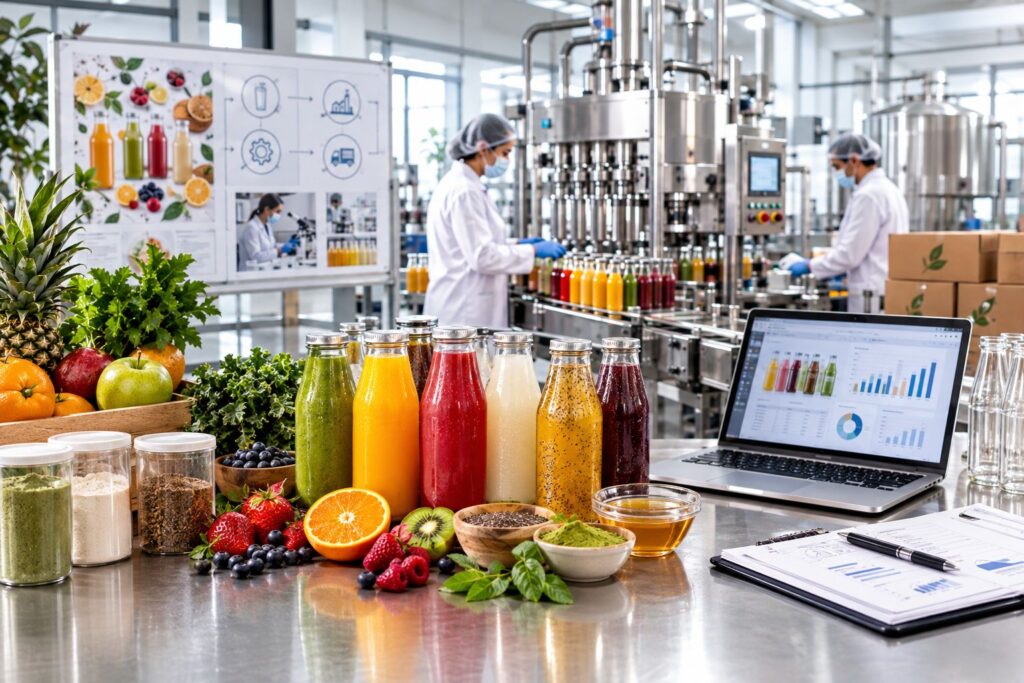
Beverage contract manufacturing process with production, bottling and packaging
FFCE

Contract Manufacturing Model for Beverages – Advised by Food Consultant

Beverage start-ups can bypass costly initial setup costs of a fully established beverage unit by utilizing the contract manufacturer, which allows them to outsource the production of their beverage to an expert facility. With a food technologist or consultant, companies can ensure quality control, regulatory compliance, product standardization, and proper scale up. This is an ideal strategy to start or scale innovative beverage products because they provide flexibility, faster time to market, and less risk with investment. Introduction The beverage industry is experiencing a boom in innovation, with both health-conscious and adventurous consumers showing a strong interest. For a beverage unit startups and mid-sized brands, however, establishing an internal manufacturing facility to satisfy this demand can be costly, time-consuming, and hazardous. At this point, contract manufacturing emerges as a tactical option that helps businesses launch premium beverages more quickly and effectively. When it comes to helping beverage, unit navigate the contract manufacturing route, a food consultant or food technologist is essential. A well experienced food technologist and food consultant guides us to save time and money on everything from choosing the best manufacturer to guaranteeing product safety, compliance, and formulation accuracy. Products developed 0 + Years experience 0 + Countries served 0 + Clients served 0 + What is Contract Manufacturing in the Beverage Industry? Contract manufacturing is entering into an agreement with a third-party facility that has the infrastructure, technicality and licenses required to manufacture your beverage. The contract manufacturer handles actual production, packaging, and sometimes logistics. This model is perfect for companies that wish to: Don’t want to spend money on a full-fledged beverage unit. Rapidly increase the beverage production. Test and analyse new beverages in the market before larger production volume. How to Implement the Contract Manufacturing Model — With Help from a Food Consultant Product Development and Standardisation You must standardize your recipe before approaching any contract manufacturer. A food technologist ensures that your beverage’s flavor, nutritional profile, shelf life, and appearance are all consistent.A food technologist also helps to choose preservatives, stabilizers, and flavorings that are suitable for your target market. Manufacturer Selection A food consultant will assist in creating a shortlist of trustworthy contract manufacturers who specialize in the beverage you’re introducing, such as juices, carbonated drinks, cold brews, or health tonics. A food consultant also assess the manufacturing setup, quality control procedures, licenses (such as FSSAI), and previous customer performance. Batch Trials and Scale-Up The food technologist ensures that taste and quality are achieved; oversees pilot tests; and modifies formulations for commercial equipment. They also assess the behavior of ingredients in bottling, carbonation, and pasteurization. Packaging and Labelling Compliance Packaging is not just about appearance,this needs to comply with food safety regulations, protect the product, and appeal to your customers. The food consultant helps choose appropriate packaging (PET, glass, Tetra Pak), and makes sure the label complies with FSSAI guidelines regarding shelf life and nutritional claims. Quality Control and Documentation Maintaining product safety and hygiene is one of the primary functions of any beverage unit. Your food consultant helps you develop QC protocols and test parameters (such as pH, TSS and microbial counts), alongside involvement in third-party lab testing. This ensures each batch meets specifications and provides confidence for the customer. Advantages of Contract Manufacturing for Beverage Low capital investment as there’s no need to build your own beverage unit. Use your current manufacturing setups to get products to market quickly. You can easily change or increase the amount of production based on what the market needs. For formulation and quality assurance, contact knowledgeable teams and food technologists. Focus on core like branding,sales and marketing while production is outsourced. When to Consider Setting Up Your Own Beverage Unit? Brands may think about establishing their own beverage unit when they reach a steady sales volume, wish to safeguard proprietary formulations, or want complete control over production schedules, even though contract manufacturing is best for starting and growing. Conclusion Contract manufacturing is a clever, low-risk strategy for beverage startups and growing brands to break into the cutthroat drink market. Without the hassle of running a full-scale beverage unit from the start, you can make sure that your beverage concept becomes a safe, scalable, and shelf-ready product with the help of an experienced food consultant or food technologist.

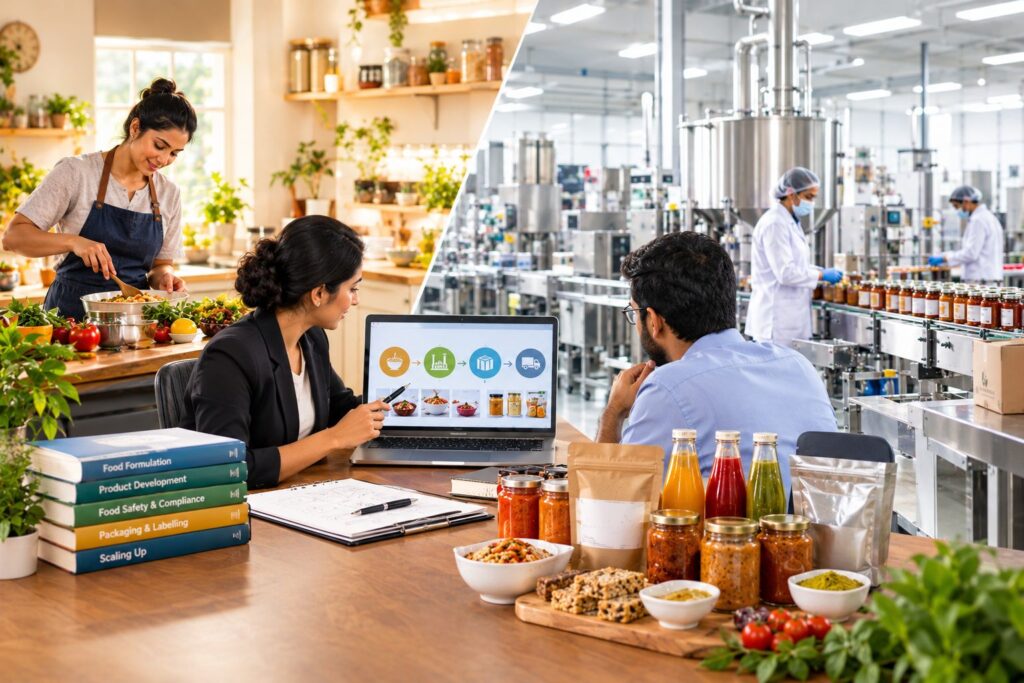
Transitioning a food product from kitchen production to commercial factory manufacturing
FFCE

Kitchen Recipe to Factory Setup — Role of a Food Consultant

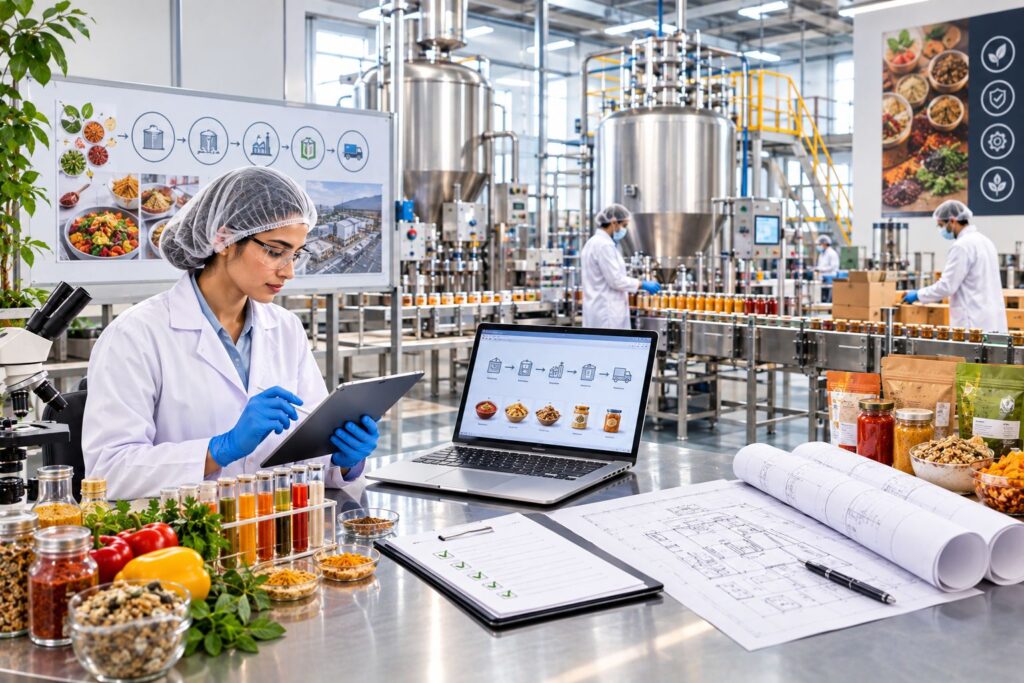
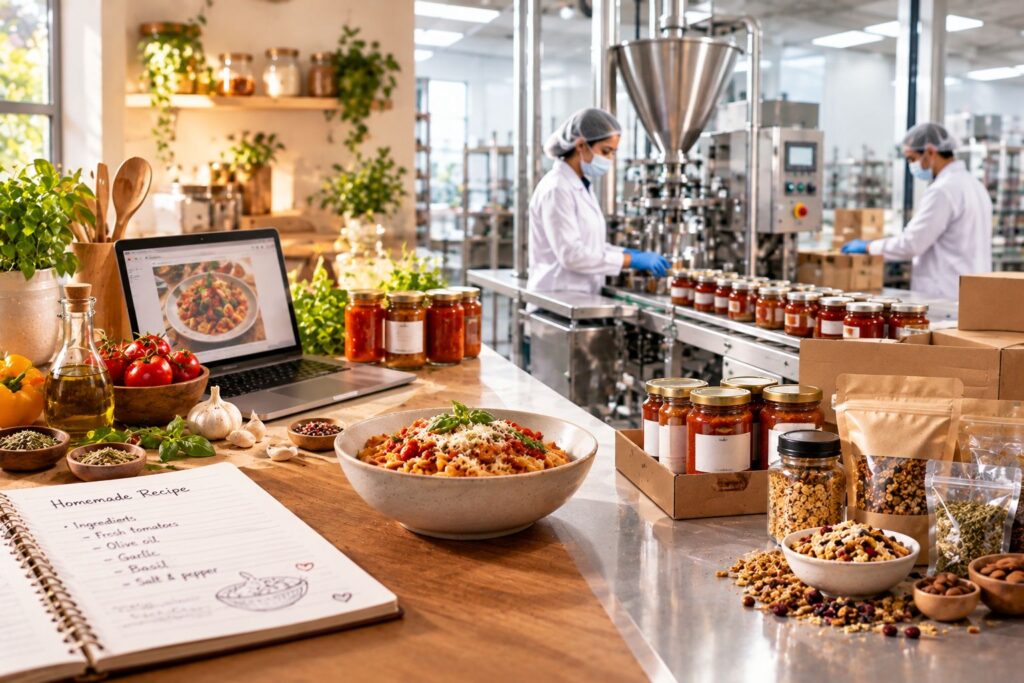
Expertise in product scaling, recipe standardization, and knowing how to develop an efficient plant layout are critical moves to take an incredibly good food recipe into a viable commercial product. A food consultant, works along with a food technologist to adapt a recipe for commercialization, ensuring replication at mass levels, maintaining its quality and the facility meets the regulations. Their expertise and guidance enable you to move from making food in the home kitchen to having a food brand ready! Introduction It is not an easy task to bring a popular kitchen recipe to a large-scale commercial operation. Even though the original concept may have come from tradition and passion, it takes a methodical approach to turn it into a marketable product. A food consultant can be a very useful partner in this situation. With the assistance of qualified food technologists, food consultants help aspiring business owners at every stage of their food enterprise journey, from product scaling to plant setup and regulatory compliance. Products developed 0 + Years experience 0 + Countries served 0 + Clients served 0 + The First Step: Recipe to Scalable Product Large-scale production is not possible for everything that functions well at home. A recipe designed for five servings may not function the same way when multiplied by five thousand. Product scaling enters the picture here. To keep the original flavors, textures, and appearances of a recipe but adapt it to commercial levels of production, a food consultant works in coordination with a food technologist. It is important to know how the ingredients will act in terms of shelf life, microbial safey, package intent, and cooking methods before product scaling up the best practices. If a recipe called for a spice blend, for example, the spice blend could also need to be reformulated too, if it has an adverse response to industrial heating or preservation methods. The expertise of food technologists allows for this harmony between science and culinary art. Product Standardization & Shelf-Life Testing Standardization is a crucial next step after product scaling. Consistency is the most crucial element in the food industry. All units must be identical in flavor, aroma, and appearance. The food technologist will test for shelf life and stability of the food products and the food consultant will make sure each production of the product conforms to established standards. This scientific testing will guarantee food safety and appeal to the consumer, but it will also help to determine the best packaging material and additives (if required), and storage conditions. Plant Setup Designing the Right Infrastructure A proper plant setup is necessary for the transition from a test kitchen to a commercial kitchen. Plant setup entails figuring out workflow design, utilities, hygienic zones, equipment needs, production capacity, and even employee training. A food consultant assists in creating a layout that facilitates efficient operations, conforms to food safety laws, and permits future growth. The food consultant evaluates 1.Type of food product 2.Required machinery 3.Water and energy needs 4.Waste management system 5.Clean room and contamination control areas. Depending on the type of product, each plant setup has a unique design. For instance, the equipment and layout of a bakery will differ from that of a sauce or beverage processing facility. Compliance and Licensing Support Adhering to legal compliance for food safety and getting licenses such as that given by the FSSAI in India is yet another requirement for plant setup. Food consultants assist clients with documentation, auditing, and certification. A food consultant also determines whether clients’ food and drinks manufacturing plants conform to the required industry standards (like Good Manufacturing Practices (GMP) and Hazard Analysis and Critical Control Points (HACCP)). Production Trials and Commercial Launch Food consultants manage pilot batch trials ahead of commercial production runs. Doing so improves efficiency, provides evaluations for the yield and quality of the production lines, and highlights issues for bottlenecking. Also, this is where we fix anything that isn’t working with the formulations, packaging, and flow of process. Once process validation is complete and the product is prepared for commercial release, the food consultants often provide continuing advice, to help resolve production issues and optimize costs without the sacrifice of quality. Conclusion Scaling a recipe from kitchen to market is much more than just passion, it takes technical knowledge. With the right support with respect to product scaling, formulation and plant set-up, entrepreneurs can ensure consistent quality and meet regulatory compliance. With the help of a food consultant, knowledge of a food technologist, and a thoughtfully constructed facility, entrepreneurs can take a passion and create a viable and sustainable business. Whether your recipe is a contemporary energy bar or your grandmother’s pickle, professional input, and the proper planning present the most opportunities to go from small batch to shelves.

Urban spice blends developed with modern food technology and seasoning expertise
FFCE

How to Develop Urban-Friendly Spice Blends — Food Technologist Insights

With an emphasis on convenience, health, and international flavors, urban-friendly spice blends are changing the facebook of food industry. To create clean-label, preservative-freeb and minimalistic blends that suit contemporary urban lifestyles, food consultants and food technologists are essential to product innovation. The spicy blend category is evolving quickly, moving away from functional and fusion blends to dry rubs and ready-to-use sachets. With fast-paced consumer trends, brands find that they can take spice blends to market and scale successfully with professional assistance with formulation, shelf-life and packaging. Introduction The food preferences of urban consumers are changing more rapidly than ever. Convenient, flavorful, and wellness with spicy flavor blends are attractive to working urban consumers. With convenience, flavor, health consciousness, and busy lifestyles, flavor blends will continue to transition fast and flavorful. Consumers are looking for authenticity, nutrition, wellness and utility, along with creativity and flavor. There is great potential for food technologist and food consultant skills in this area whereas a food technologist could drive product development and, food consultants could introduce authentically urban-inspired flavors blends to food and drink, with their product development. Products developed 0 + Years experience 0 + Countries served 0 + Clients served 0 + Understanding Urban Preferences Urban markets are driven by fast-paced lifestyles and fickle food preferences. While urbanites have less time than ever before, they will not sacrifice quality or flavor. Urban consumers are looking for spice blends that are quick, easy to use, and have big flavor and aroma. Preservative-free and clean label seasonings are no longer luxuries—they are required. Urban consumers love experimenting with bold international flavors, such as korean, mexican, japanese, and even thai. Thus, food technologists and food consultants must develop spice blends that achieve the right harmony between shelf stability, flavor, health, and clever packaging – creating real product innovation for a new age of inquisitive consumers. A food consultant assists companies in deciphering these tastes and incorporating them into physical goods. Finding gaps in the current offerings, sensory profiling, and market research are the first steps in this process. For instance, low-sodium spice blends and seasoning mixes that include superfoods like flaxseed or moringa are becoming more and more popular. The Role of the Food Technologist All spice blends are subject to food technologist testing to ensure they are not only sensory appealing, but that their production is technically viable for scale up. According to food consultant, the science of spice is an important part of the process, from alignment of blend ratios to standardization of aroma, flavor, and texture from batch to batch. Some of the important tasks of the food technologist include: 1.Sourcing and qualification of ingredients: selecting the quality of herbs and spices, usually balancing local with imported varieties. 2.Blending and trial batches: achieving repeatable consistency between mix stability, particle size distribution, and grind size. 3.Shelf-life testing: testing the spice blend for microbial and sensory characteristics over several months to determine ‘best before’ dates. 4.Packaging innovation: choosing the right barrier packaging materials for urban storage to provide optimum protection from oxidation, light, and moisture. The food technologist draws on culinary and food science expertise to formulate spice blends that are scalable, clean, and functional for urban spaces. Product Innovation in Spice Blends The spice blends of today include much more than just sambhar powder and garam masala. Real product innovation is about creating formats and functionalities to fit urban lifestyles. Here are some trends: Cross-cooking blends Functional spices Meal specific sachets Instant marinades and dry rubs A food consultant plays a strategic function to help brands navigate the ideation and launch process defining the niche, final blend profiles, and piloting manufacturing at small scale. Commercialization and Plant Setup When you think of spice blend concept to finished product you might think about a recipe only. While recipe development is a part of the process, there are other important things to consider as to how you’ll develop your spice blend to go to market such as production planning, capital investment in equipment, and food quality risk management. A food technologist can help design the physical plant, determine what grinders, blenders, and sieving solutions are appropriate for all spice formats.Urban friendly spice blending always has resealable pouches, nitrogen flushing, or vacuum sealing packaging innovations that leverage the sectors daily retail environments and behaviors. It takes professionals who know the balance between ensuring freshness for the product and as a method to achieve better logistics. Conclusion To transform a kitchen experiment into a well-liked urban spice blend, creativity, science, and meticulous preparation are required. Through a food consultant and a food technologist, brands can invoke legitimate product innovation in the spice market. By understanding urban needs, creating clean-label blends, and maintaining technical specification compliance, you will be able to add tasty, practical, and future-proof spice products to today’s quickening consumer marketplace.The basis of each spicing blend is always original thought through to accuracy – whether you are creating a regional spice blend with a modern flair, or a marinade with exotic origins.

Food technologist overseeing turnkey food factory setup and production planning
FFCE

The Role of a Food Technologist in Turnkey Food Factory Setup Projects

The work of a food technologist is significantly crucial in turnkey food factory build, supporting each phase from product development, equipment selection, quality control and regulatory compliance. The food technologist would usually operate individually or with a food consultant to streamline the entire food factory build process ensuring it is compliant, operational, and sustainable. Introduction The process of establishing a food factory from the ground up is a much layered, complex project which requires knowledge in multiple areas. One of the most important contributors to the successful planning of turnkey food factory projects is a Food Technologist. As the food and beverage industry quickly changes in response to consumer demand, health fads, and regulations, Food Technologists have become vital to driving innovation and ensuring compliance in food manufacturing environments. Products developed 0 + Years experience 0 + Countries served 0 + Clients served 0 + What Is a Turnkey Food Factory Setup? A turnkey project is a facility that is equipped and ready to operate, given to the client in accordance with the contract. In the food industry, it takes the project from inception (planning and design) to selection of machinery, installation of machinery, product development, packaging, quality control systems and regulatory compliance. Those in the food industry prefer a turnkey solution just to minimize the hassle of dealing with multiple vendors and going through a variety of accountability points.   The food technologist is very important here, as they facilitate the transformation of ideas (from raw concepts) into reality. The Critical Role of a Food Technologist Food technologists have the scientific and technical expertise to ensure the result of a facility operates properly and produces safe, quality outcomes. The activity of a food technologist can cover the complete life cycle of a turnkey project from start to finish. 1. Product and Process Development Before any factory can be built, it is important to understand what the products being produced will be. A food technologist assists a food company in developing the recipes, formulations, and processing parameters to ensure that at any scale from lab testing to pilot plant to production scale – the processes produce consistent taste, texture, shelf-life, and nutrition. 2. Equipment and Layout Planning Selecting suitable equipment is critical to achieve a stable output and sustainable efficiency. A food consultant who has a background in food technology will work with you to ensure the machinery you select is suitable for the characteristics of your food product, and for food hygiene purposes. They will impact the layout of the factory to accommodate the food production workflow while remembering the requirements for food safety, for example, to minimize the risk of contamination and whether it meets HACCP or FSSC 22000 standards. 3. Regulatory Approval Food topic adds many stakeholders involved in food production operations. Food technologists navigate stringent local and international regulations while ensuring all aspects comply with food laws, including all inputs, processes, labelling and packaging. When establishing the plant, a technologist will engage all regulators as well as help obtain all certifications and licenses needed for the operation of the plant. 4.Quality control and safety systems Creating and establishing quality control systems is another way in which food technologists add value. They will provide SOPs, CCPs and testing regimes to follow to make certain each product is consistent and meets specifications. Their experience means that food safety risks are recognised and controlled from day one. 5.Staff training and SOP Once the factory is ‘up and running’, all staff need to be trained to abide by food safety practices and operate the equipment properly. A food technologist aids in developing the contracted SOPs and trains the operators, supervisors and the quality control staff to ensure production standards are met and to avoid issues such as cross-contamination, spoilage and/or incorrect operation of equipment. 6.Research and innovation A turnkey project goes beyond simply setting up a factory. Markets change, and food technologists remain involved for research and development of new products, packaging, and process work. This ensures that the factory is relevant and responsive to changes in the marketplace. Working with a Food Consultant Often, food businesses will hire a food consultant with turnkey experience designing multiple factory setup projects. This individual usually comes with a “team”, including food technologists, engineers, and incorporation/safety regulatory experience to follow through with end-to-end execution. These experienced food consultants have had “real work” experience about avoiding mistakes, delays and non-compliance. Finding the right consultant or in-house food technologist early in the planning process could mostly save time and money and set the stage for long term success. Conclusion In the assignment of turnkey food factory setups, the food technologist is both at a strategic level and at a hands-on level throughout the process. They are responsible for the initial product development, machine selection, quality assurance and regulatory compliance, etc. They will help make sure the product, the machine, and the process are scientifically sound and commercially viable. Regardless of whether they are working alone or as part of a broader food consultant team, food technologists are really the engine behind successful food manufacturing businesses. A good food technologist will not only help you get your factory launched more quickly, but they will also help you be sustainable and compliant in the long term.

Scaling homemade recipes for commercial food production and manufacturing
FFCE

Scaling Homemade Recipes to Commercial Batches – Ask your food consultant

Scaling a homemade recipe for commercial production doesn’t just involve increasing the quantity of ingredients, or randomly mixing everything up. There are considerations of standardization, exact ingredient scaling and good advice from a food consultant. Consistency in flavor, texture, shelf stability and safety is essential because in a bulk scenario, ingredients act differently. A food consultant can help to reformulate recipes, provide shelf life and legal requirements; ultimately reducing the risks and increasing successful commercial viability. Any food entrepreneur intending to scale a homemade recipe for a reliable, commercial product should consult a specialist. Introduction The process of launching a homemade recipe is very interesting and fascinating nowadays. Making your family’s secret chutney, homemade traditional pickles, granola, or that special herbal tea blend that everyone adores takes more than simply multiplying ingredient quantities to go from a home kitchen to a large-scale food production operation. Recipe scaling, standardization, and knowledge of food consultant are all part of this delicate process. Let’s examine how recipe scaling operates and why seeking expert advice is necessary to ensure the commercial success of your food product. Products developed 0 + Years experience 0 + Countries served 0 + Clients served 0 + Understanding Recipe Scaling Scaling a recipe may seem simple at first glance. Would you not simply multiply everything by a certain number of yields servings, and it Servest’s not that simple. In large quantities, ingredients don’t always act in the same way. Stabilizers, leavening agents, and spices, for example, do not scale linearly. Instead of causing rise, too much baking powder can cause collapse. The product may become inedible if it contains too much salt or spice. The finished product is even affected by variables like equipment, cooking time, and temperature distribution. Recipe scaling turns into a technical art at this point. It’s food science, not just math. The Role of Standardization After adjusting a recipe for scaling, the next step is standardization. Standardization is making sure that every time a recipe is produced, each batch is the same about flavor, aroma, appearance and texture regardless of where or when you produce it. Standardization will consist of establishing quality control checks, documenting the processes and defining the ingredients. You are required to do this to maintain your customers’ trust. Rarely, in the absence of standardization, can you deliver a consistent and effective result without damaging your brand. Why You Need a food consultant. A food consultant is essential in this situation. Even though your culinary intuition is useful, commercial production adds factors like batch testing, shelf-life stability, microbiological safety, packaging compatibility, and legal compliance that you might not have known existed. A food consultant can assist by:  Reworking recipes to preserve texture and flavor in bigger quantities suggest appropriate preservatives or processing methods for longer shelf life, design trials and scale-up experiments are conducted before full production, create Standard Operating Procedures (SOPs) batch-wise and verify that the product satisfies FSSAI or other legal requirements. Working with a food consultant. Increases the chances of a successful market launch and lowers the risk of expensive production errors. Real Challenges in Recipe Scaling When scaling recipes, entrepreneurs frequently encounter the following difficulties: Change in texture- On a larger scale, creamy sauce may thicken or separate differently. Balance of flavors- In larger batches, herbs or spices may become overpowering or fade. Limitations of the equipment: Industrial mixers and boilers are not replicated by home blenders or pans. Shelf-life issues: Unless they are redesigned, homemade goods without preservatives may go bad very quickly. Final Thoughts: Ask Your Food Consultant If you are serious about your food product development, it is always a great idea to talk to your food consultant before you begin large scale production. Your food consultant will guide you throughout the scale-up, help you avoid trial-and-error mistakes, and make sure your final product will be safe, delicious, and consistent enough for sale. Taking a recipe to a successful commercial product takes science and planning and knowledgeable execution, not just passion. The right food consultant can help you make your homemade dream a brand reality.

Scroll to Top

Your Trusted Food-Tech Partner Simplifying Solutions, Maximising Success

    Your idea is 100% protected by our Non Disclosure Agreement

    What is Refresh icon

    Your Trusted Food-Tech Partner Simplifying Solutions, Maximising Success

      Your idea is 100% protected by our Non Disclosure Agreement

      What is Refresh icon

      Your Trusted Food-Tech Partner Simplifying Solutions, Maximising Success

        Your idea is 100% protected by our Non Disclosure Agreement

        What is Refresh icon

        Powering your food business forward