

FFCE

Now Hiring: Are you a driven and motivated 1st Line Food Technologist?

Author name: Admin

Natural and synthetic food color additives used in food products
FFCE

Color Additives in the Food Industry

The appearance of a food is largely determined by its colour, and subsequently the texture.   Food choice and perception are greatly affected by color.  If the strawberry ice cream appears to be white, or a chocolate biscuit appears pale yellow, it loses its credibility and the excitement of the customer is also lost. This creates a negative impact on the brand’s identity. Hence, colours are important in adding the aesthetic to the food. However, there is a shift in the food market from using petroleum based colours to using plant derived and clean label additives. Consumers are also getting aware about this. A good food consultant can assist you in choosing the right clean label colours for the wide range of processed food. The History of Colors in Food As the era of processed foods began in the late 20th century, the use of the synthetic colours caught the pace due to the affordability, excellent stability, and wide range options. Gigantic amounts of brightly colored baked goods, candies, soft drinks, and snacks were made in great part due to these petroleum-derived artificial dyes. Common synthetic pigments consisted of the following: Yellow No. 5 Tartrazine or tartzine Yellow No. 6 The Sunset Yellow FCF Blue No. 1 (Bright Blue FCF) Red No. 40, or Allura Red AC Although such dyes satisfied functional and economic requirements, food safety authorities and consumer groups started observing them closely because of increasing scientific evidence indicating that some food color additives caused children to be hyperactive, induce allergic responses, and are possibly carcinogenic. If you ever find yourself in the dilemma of which color additive to use, you can always take the support of a food consultant, such as the Frontline Food Consultant and Engineers (FFCE), who have a proven experience in in this area. Products developed 0 + Years experience 0 + Countries served 0 + Clients served 0 + Regulatory requirements of FDA and FSSAI FDA Banned/Additive List, United States The United States Food and Drug Administration (FDA) has a strict list of color additives which are allowed and banned. A number of dyes have been banned over the years because they are toxic and include: The Number 2 Red/ Amaranth Red: Ceased to be used in foods since 1976 for the risk of cancer causing compounds. Violet No. 1: Banned for lack of adequate safety information. Citrus Red No. 2: Restricted use; used to color orange peels only. Also, the FDA continues to regulate 21 CFR Parts 70–82 rules on certified dyes and, for safety purposes, mandates batch certification for artificial colors. India: FSSAI Guidelines The Food Safety and Standards Act of 2011 has permitted the use of natural as well as artificial color additives in foods, however in regulated quantities. The following artificial dyes are permitted: (INS 102) Tartrazine FCF Sunset Yellow (INS 110) FCF in Brilliant Blue (INS 133) (INS 122) Carmoisine But certain food categories limit the application of particular colors, like erythrosine (INS 127), and their use in the long term is under consideration. The transition towards natural colorants has been given importance by the FSSAI in recent updates, particularly in the infant, child, and health-related categories. Types of Color Additives in Foods The color additives can be classified broadly as: 1. Synthetic (Artificial) Colors / Petroleum-derived Deliver vivid, reproducible coloration Heat, light, and pH stable Examples: Red 40, Blue 1, Yellow 5 2. Natural Colorants From plant, animal, or mineral sources May be temperature-, pH-, and oxidation-sensitive Usually “clean label” promoted Examples: Anthocyanins (berry, purple cabbage) Carotenoids (beta-carotene, paprika, lycopene) Chlorophylls (leafy greens) Curcumin (turmeric) Beetroot Red (betanin) Spirulina Extract (blue-green algae) Emerging Trends: The Age of Naturally Derived Colors Food processors and food manufacturers are now reformulating their products to replace synthetic color with natural ones, due to: Clean label demand Health consciousness on the rise Regulatory pressures Sustainability concerns Additional Recent Naturally Occurring Innovations Are: Purple Sweet Potato Extracts – Rich in anthocyanins; applied to candies and drinks. Microalgae-Derived Phycocyanin – Blue colour from spirulina, stable and accepted in a number of markets. Fermentation-Derived Colors – Biotechnologically derived pigments (e.g., Monascus red, fungal melanin) for greater stability and scalability. Gardenia Blue and Yellow – From gardenia fruit, well-liked in Asia and presently gaining interest globally. Challenges in Using Natural Colors: Color instability (specifically to light or pH change) Higher cost Limited shade range Label complication (as a few extracts may not be labeled as “additives” according to source and country regulations) Conclusion The food market is going through a shift from artificial to natural coloring. As consumers more and more focus on reading the label, manufacturers are left with the challenge of creating plant-based, fermented, and bio-tech manufactured colors that, in addition to being safe, are also desirable. Product developers, food technologists, and regulatory experts need to navigate carefully the esthetic needs, processability, and regulations. Into the horizon of food color move sustainability, transparency, and natural innovation — where what is good to eat, feels good to eat too.
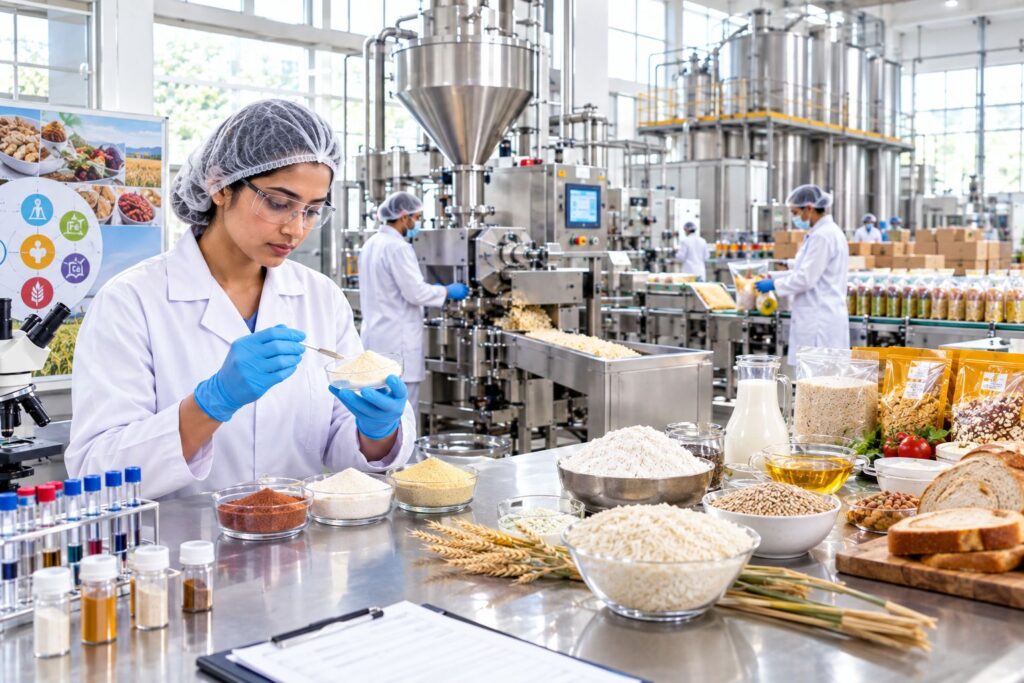
Food fortification in India with essential vitamins and minerals added to food products
FFCE

Food Fortification in India

It is a serious problem to ensure nutrition in a densely populated and diverse country like India. The population of India silently endures the problem of hidden hunger or pseudo hunger, which is the deprivation of micronutrients within the diet of the masses. To curb this issue, food fortification has come up as a cost-effective strategy.   But fortification is not just adding more nutrients—it is all about having serious expertise in food science, regulation, consumer insights, and scalable food processing technologies. That is where expert food consultants like Frontline Food Consultants and Engineers (FFCE) step in and revolutionize the Indian food industry. What is Food Fortification Food Fortification is the process of adding vital nutrients to a food, in which that nutrient is not innately present. Micronutrients such as iron, zinc, calcium, vitamins such as vitamin c, vitamin B12, etc are the most common nutrients using which processed foods are often fortified. Why Fortification Is Important in India: High rates of deficiencies Based on the National Family Health Survey (NFHS-5), over 50% of Indian women and children are anemic. Cost-effective intervention Fortification is easier compared to supplementation programs as it can be done through current food systems with little change in behavior needed. Wide reach Staple foods have a wide reach, covering millions, thus suitable for mass fortification. Government and Regulatory Support The Indian government, through FSSAI’s ‘+F’ logo initiative, has strongly advocated fortification in key food segments. Mandatory fortification of iodized salt is already in place, while edible oil and milk fortification have been scaled across various states. Rice fortification through the Public Distribution System (PDS) is another flagship step under the Poshan Abhiyan. Preventing sensory modifications such as off-flavors or color changes. Compliance with FSSAI norms and global standards. Optimizing cost-effective and scalable production processes. This is where sector specialists such as FFCE come in to fill the knowledge and implementation gap. Below is how FFCE aids food fortification activities: Formulation & R&D Client-specific product category custom fortification premix development. Balancing texture, taste, and nutrient retention via cutting-edge food engineering. Prototype creation and product testing. Process Development Development and verification of scalable production processes to provide even micronutrient distribution. Choosing suitable mixing, blending, and extrusion equipment for fortified foods. Shelf life testing and thermal process validation. Regulatory Compliance FSSAI compliance assurance for fortification regulations and labeling standards. Facilitating license applications under fortified food categories. Document assistance for schemes like Eat Right India or Poshan Abhiyaan. Turnkey Solutions nstallation of fortification-capable production facilities, from raw material receipt to packaging. Machinery integration of batch and continuous fortification systems (for instance, for fortified atta, milk, edible oil, etc.). Manpower training and quality control teams. Looking Ahead: The Fortification Frontier India’s food fortification adventure has just started. With a drive towards voluntary fortification of rice, increasing school and ICDS feeding schemes, and increasing consumer awareness regarding nutrient-based diets, the market for fortified foods is set to expand exponentially. This presents a strong challenge for food companies, startups, and contract manufacturers to invest in fortified products—not only as a corporate social good, but as a business imperative. And in doing so, FFCE is a trusted partner, breaking down complicated technical needs into realizable, sellable products. Conclusion Food fortification is more than a policy—it’s a force to reform the health and wellbeing of a nation. Yet for it to be effectively scaled, technical know-how, regulation know-how, and operational accuracy are essential. Frontline Food Consultants and Engineers (FFCE) provides just this combination, enabling companies to responsibly innovate and deliver nutrition on every plate.

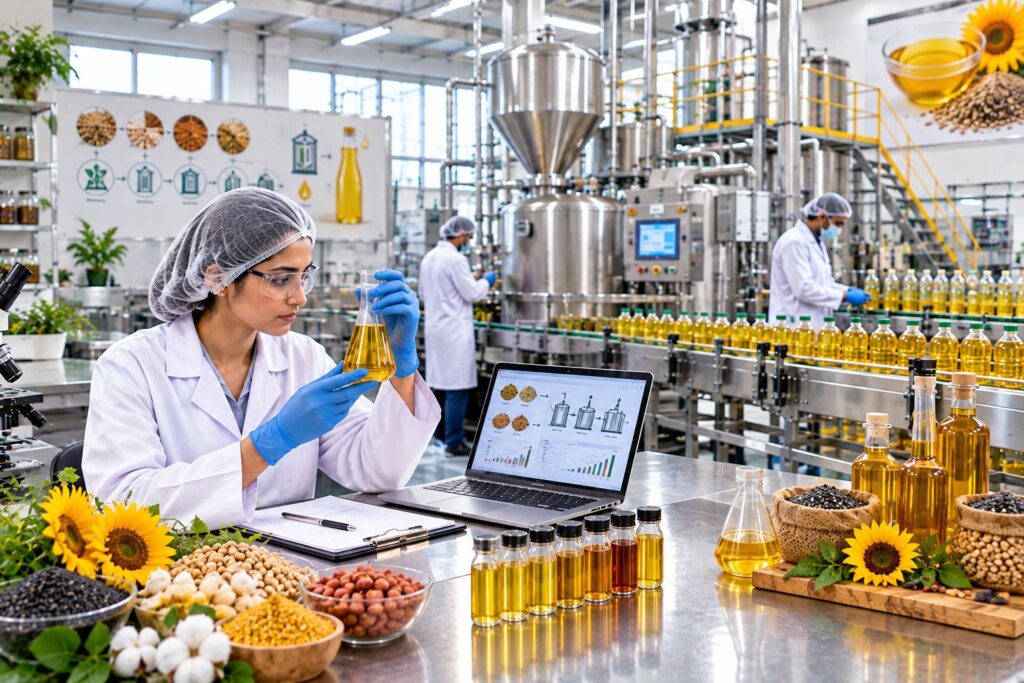
Cooking oil processing and manufacturing with food processing consulting
FFCE

Various Types of Cooking Oils

Cooking oils form an essential part of all kitchens, be it the conventional Indian home or international food production conglomerates. In addition to flavor, oils determine texture, nutritional content, shelf life, and even regulatory status of food items. With the variation in types of oils, coupled with the fineness of their extraction and processing methods, this is a dynamic segment within the food sector. At Frontline Food Consultants and Engineers (FFCE), we help businesses that want to innovate, grow, or optimize their cooking oil lines,whether it’s introducing cold-pressed artisanal oils, establishing refinery units, or creating value-added oil blends with functional health claims. Classification of Cooking Oils Cooking oils can be generally classified according to their source and processing method:Source-Based ClassificationOilseeds: Flaxseeds, cottonseeds, safflower, mustard, sesame, sunflower seeds.Oil nuts: Macadamia nuts, almonds, peanuts.Oil rich fruits: olives, avocados.Grain Oils: Corn, rice bran.Tropical Oils: Coconut, palm, palm kernel. Processing-Based Classification Cold-Pressed or Virgin OilsExpeller-Pressed OilsSolvent-Extracted OilsRefined OilsBlended and Functional Oils Products developed 0 + Years experience 0 + Countries served 0 + Clients served 0 + Various methods of processing cooking oil Each type of oil source goes through a set process flow depending upon the raw materials used, type of functionality, and the target audience. Cold-Pressing (Mechanical Pressing) Suits well for: Sesame, groundnut, coconut, olive.Process: Oilseeds are crushed at low or ambient temperatures (typically <50°C) in order to maintain natural antioxidants, aroma, and flavor. Advantages:Maintains vitamins (such as Vitamin E), polyphenols, and phytosterols.Clean label appeal: no chemicalsApplications: Specialty oils for salad dressings, artisan cooking, or ayurvedic application. Expeller/ Mechanical Pressing Process: Oilseeds are pressed mechanically at higher pressures and moderate temperatures (~60–100°C).Efficiency: More oil output than cold pressingUse Case: Employed extensively in medium-scale edible oil units. Solvent Extraction (Hexane-Based) Used for oil seeds such as the soybean, rice bran, cottonseedProcess:De-oiled cake of expellers is hexane-treated.Oil is recovered, followed by recovery of hexane through desolventisation.Advantages:Maximum yield (~99%)Economically feasible for large-scale productionLimitation: Post-refining to eliminate residues of the solvent Oil Refining (RBD Process – Refined, Bleached, Deodorized) The oil refining process enhances the colour, flavour, odour, and stability of the oil while making it more shelf stable. Refined oils are usually cheaper as compared to cold pressed oils. Steps involved Degumming (the process of removal of phospholipids)Neutralization (omission of free fatty acids)Bleaching (pigment removal using earth/clay)Deodorization (steam distillation to eliminate odor volatiles at 180–240°C under vacuum) FFCE assists clients in optimizing these unit operations based on the type of oil and regulatory target (FSSAI, Codex, etc.). Winterization (Dewaxing) Highly important for sunflower, olive and rice bran oil.Removes waxes and high melting triglycerides to ensure clarity at refrigeration temperatures. The New Trends in Cooking Oils The Indian edible oil industry is growing at a fast pace, and is witnessing a clear shift towards health-oriented oils such as the Rice bran oil (gamma-oryzanol-rich), flaxseed oil (omega-3), olive and avocado oils (monounsaturated fats). Moreover, the demand for blended oils (mix of PUFA and MUFA for cardiovascular well-being) is also increasing amongst the urban population. Fortified Oils such as with the nutrients vitamin A & D fortification as per FSSAI mandate for public health schemes, is also gaining popularity for healthy well-being.   FFCE enables the incorporation of premix nutrients in oil lots with homogeneous dispersion and stability confirmation.   Cold-Pressed and Organic Segments: High-end product lines for clean-label and artisanal categories. Demands special attention in material sourcing, low-temperature handling, and preservative-free packaging. Sustainable and Zero-Waste Processing: Valorization of by-products such as de-oiled cakes, wax, fatty acids, and phytosterol extracts.Applied in feed, cosmetics, and nutraceuticals—FFCE provides end-to-end value-chain assistance Sustainable and Zero-Waste Processing: Valorization of by-products such as de-oiled cakes, wax, fatty acids, and phytosterol extracts.Applied in feed, cosmetics, and nutraceuticals—FFCE provides end-to-end value-chain assistance FFCE’s Contribution to Cooking Oil Processing Projects At the Frontline Food Consultants and Engineers (FFCE) , we assist the emerging and old food business operators with all the necessary cooking oil operations—be it a startup, SME, or large company. We assist the clients for the following aspects: Plant Design and MachineryOil expeller plants (5–200 TPD)Solvent extraction and refining linesCold-press lines with temperature controlDewaxing, deodorization, and bottling integrationFormulation & R&D:Development of blended oils (e.g., rice bran + safflower)Flavor-infused oils (herb, garlic)Fortification with vitamins or functional compoundsShelf-life modeling and oxidative stability testingCompliance and Certification:FSSAI edible oil standards and packaging standardsFortification logo (“+F”) and nutrient content claimsOrganic, cold-pressed, and export approvalsTurnkey Solutions:Turnkey factory setup from scratch including utilities (boiler, vacuum systems, chillers)Packaging automation for pouches, PET, glass bottles, and tinsQuality assurance systems and HACCP implementation Conclusion Cooking oil is not just an ingredient, but a strategic category as it drives the health trend, innovation, and consumer loyalty. Whether you are refining for mass consumption or pressing for niche markets, processing precision and product positioning are keys to success in this market. Through technical excellence, regulatory clarity, and market-ready innovation, Frontline Food Consultants and Engineers empower oil manufacturers to confidently navigate this broad landscape.

Makhana processing machinery for roasting, grading, seasoning and packaging fox nuts
FFCE

Choosing the Right Equipment for Makhana Processing—Ask a Food Technologist

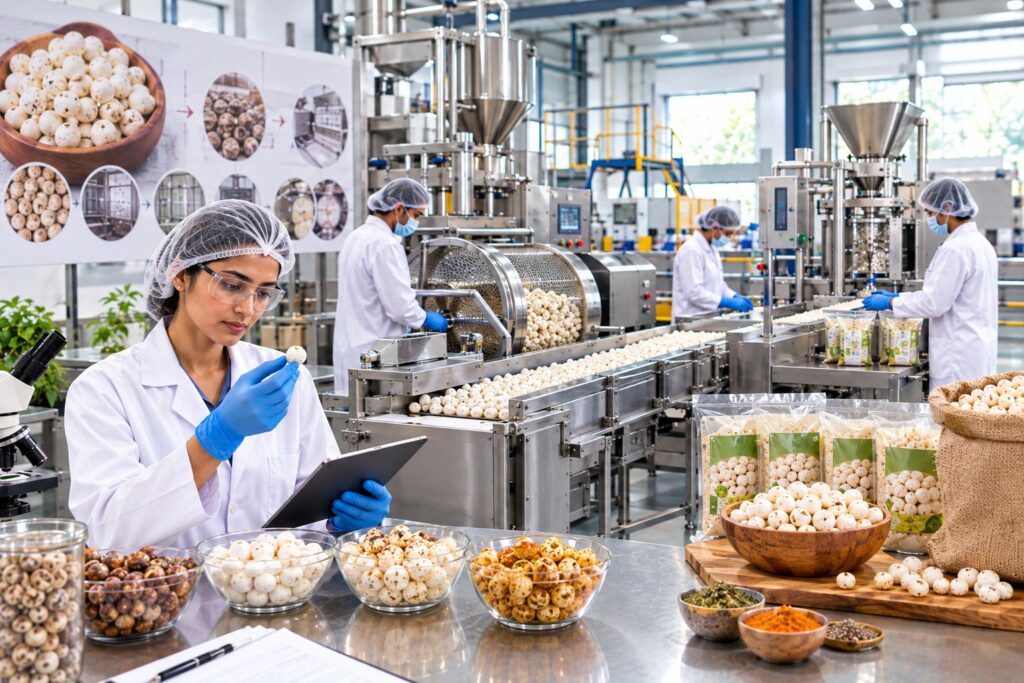
Selecting the appropriate makhana machinery is critical in building a productive and sanitary makhana snack operation. Each of the makhana processing steps; cleaning, roasting, de-shelling, seasoning and packaging all have equipment selected for them, including sand roasters, grading machines, de-shellers, and vacuum packers, which require knowledge on the food industry. A food consultant or food technologist will assist with appropriate machinery selections, developing a compliant plant layout, and standardizing the production process. A Food consultant along with a food technologist helps to simplify, produce better quality products, and become regulatory compliant, thus the food industry professionals will be a beneficial addition to any makhana based snack setups. Introduction Makhana (fox nut) has recently gained popularity as a healthy snack food because of low-calorie, low fat and crunchy texture. The demand for roasted and flavored makhana has increased significantly. The demand for processing makhana has attracted many entrepreneurs to consider small to mid-scale makhana units. Choosing the right makhana machinery is important since it will be for small to mid-scale processing and to maintain quality. A professional food consultant or food technologist can be helpful in making sure you choose the right makhana equipment and design your snack setup for commercial-scale production. Products developed 0 + Years experience 0 + Countries served 0 + Clients served 0 + Understanding the Makhana Processing Stages Before selecting the machine, it is helpful to understand the steps in makhana processing. Cleaning and Grading – Raw makhana is cleaned initially to remove dust, stones, and debris. Roasting (Popping) – This is the most important step to roast the seeds in a bed of sand to puff them up. De-shelling – The puffed makhana will need to be separated from the shells either manually or mechanically. Grading & Sorting – Makhana is sorted into different sizes, quality grades, etc. Roasting – A second, lighter roasting is completed at this stage before flavoring. Flavoring and Seasoning – Flavor can add seasoning to make the taste better. Packing – Finally, the makhana is put in packaging that is clean and won’t let moisture in. In all these steps, precision and the correct machinery are important factors in terms of hygiene and consistency. Key Makhana Machinery and Equipment A food consultant can help you choose machines based on your size of production, your budget, and hygiene factors. The following are some typical makhana machinery: Vibro Grading Machine – It separates makhana into different sizes. Makhana needs to have a consistent size for uniform roasting. Sand Roaster – This is the most traditional machine but works effectively to puff raw makhana seeds. De-shelling Machine – This mechanical machine replaces the manual labor of de-shelling. Rotary Roaster/Air Roaster – The machinery is used for final roasting, and you have control overheating. Flavor Coating Drum – This equipment helps to ensure that the seasoning is evenly mixed and prevents breakage. Vacuum Packing Machine – It prevents oxidation reactions to help prolong shelf life and keeps products fresh. For various snack setups, a food technologist can help to determine how to make machines work together & help you determine the proper steps of production. Designing an Efficient Snack Setup An effectively designed snack setup area for makhana leads to logical material flow, minimum handling and control of the hygienic environment. Some effective layout options include:Separation of raw and finished areas to prevent contamination,Ventilation and exhaust systems in the roasting areasFood processing equipment surfaces in stainless steelSeparate storage areas for raw components and finished goods Food consultants can help to design a HACCP compliant processing facility that meets FSSAI standards while optimizing productivity and space. Role of a Food Consultant in Makhana Projects Setting up a makhana processing unit, without engaging experts, inevitably leads to inefficient operations, inferior quality of finished product, and regulatory headaches. A trained food consultant or food technologist can provide: Assistance selecting the makhana machinery or equipment selection to meet your production objectives. Vendor connections to help procure reliable equipment at a competitive price. Standardization of processes to maintain taste, texture, and shelf-life. Assistance obtaining FSSAI regulatory compliance along with packaging and labelling. Cost estimating and scaling plans to accommodate future demand. Conclusion The success of a makhana brand is not only driven by high quality raw material, but also by the efficient, safe, hygienic processing of the product into value added foods. The decisions you make around your makhana machinery, the snack setup and flow of your snack food operation, and the design specifications will significantly influence the profit returned and brand value. Involving a food consultant as you start a project will shorten your time frame and assist in avoiding unnecessary trial and error costs and provide direction for a viable and successful scalable makhana business.As a startup, or as you grow an existing snack setup, ask a food technologist or a food consultant when it comes to food, guidance is everything. Frequently Asked Questions What machinery is needed for a makhana processing unit at small scale?The minimal upstream makhana snack setup required machinery would include cleaning unit, sand roaster, de-shelling machine, grading unit, flavouring drum, and packing machine. How could a food consultant assist with a makhana processing plant? A food consultant would assist with selection of the appropriate makhana machinery and equipment for the making the makhana. In addition, the food consultant would design the layout of the plant, review and document the relevant food safety regulations and assure compliance, oversee the production process and design a method to promote continuous quality improvement. Can I set up a home based or small scale makhana snack unit?Can I set up a home based or small scale makhana snack unit?Yes, it is possible to set up a small or compact snack setup as mini machinery is available for makhana snack processing. This option is mainly for local or more artisan-type production. A food consultant could help you evaluate the space available and what equipment would be required. How do I choose the right makhana roasting machine? Depending on the production scale, either a

xporting Indian spices with processing, quality control and international packaging
FFCE

Exporting Spices from India -How a Food Consultant Supports You

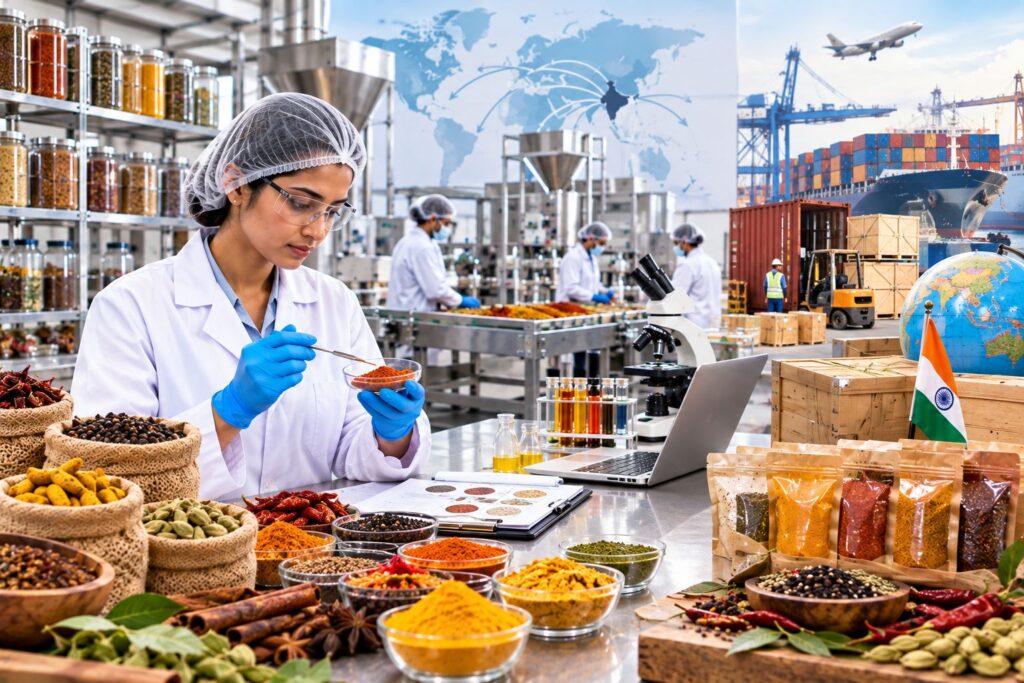
Exporting spices from India has great potential, however, serious direction is needed to comply with international standards. A food consultant has an important role to play in getting spice businesses registered with APEDA along with other regulatory requirements, as well as in completing the proper documentation for exporting spices. Most food consultants will work with a food technologist to ensure that the quality of spices is maintained, the product is standardized, and safety testing is completed so that it meets international norms. From the selection of the export-ready packaging, to labelling and shelf-life advice, a food consultant can facilitate the spice export process in its entirety. The support provided by a food consultant ensures regulatory compliance, quality assurance, and market readiness which is critical to successful global trade exported from India. Introduction India is a country of varied flavors and spices it is known all over the world for its vast range of spices. Spices, like turmeric, cumin, cardamom, and pepper, from India have become much more popular in the export arena reflecting the growth of exporting spices from India due to increasing worldwide demand for natural ingredients and ethnic ingredients. The business of exporting spices from India requires more than simply growing or packaging your spices. There are regulations regarding exporting spices, certifications and approvals that may be required, quality standards, and shipping logistics to consider. This is where a food consulting company can be your ace in your back pocket. Products developed 0 + Years experience 0 + Countries served 0 + Clients served 0 + Why Spice Export is a Lucrative Opportunity India occupies the top rank in the entire world for spice export as well as leading producer and consumer at the same time. According to APEDA (Agricultural and Processed Food Products Export Development Authority), India exported over 1.3 million tonnes of spices in the previous fiscal years. The major spice export destinations are USA, UAE, UK, Germany and other Southeast Asian countries. Despite the enormous opportunity the global market presents, accessing it involves dealing with a complicated and difficult world of legal, technical, and quality compliance. Many spice export companies newly registered In India, especially start-ups and smaller businesses are faced with this maze of; APEDA registration and export documents, quality testing and packaging, and international food safety regulations. That is where an expert food consultant and a food technologist can add value. Role of a Food Consultant in Spice Export A food consultant is a subject matter expert who helps you take your spices from a local mandi to retail store shelves, internationally. Here’s how: APEDA Regulatory Compliance Before you can start exporting spices, you need to get an APEDA registration. APEDA registration is mandatory for exporting most agricultural goods. A food consultant facilitates your:APEDA registration processSelecting helpful HS codes for your spice categoriesFSSAI licensing and complianceLabeling requirements for each countryDocumentation for customs and export houses This saves you time while ensuring your business is legally compliant for exporting. Product Standardization and Quality Testing Every importing country has its own rules for food quality standards. As one example, a turmeric consignment to the EU must comply with aflatoxin limits, and in the US the consignment must comply with unsafe/microbial protocols. A food technologist can work alongside your food consultant too:Help you keep the quality of your spice product consistentRecommend optimal post-harvest processingFacilitate selection of accredited labs to test for residuesHelp develop SOP guides for packaging and traceabilityQuality assurance is fundamental to establishing longevity of trust with the international buyer. Packaging, Shelf-life & Labelling Support Export packaging is different than what you would do when packaging for the domestic market. You will need to comply with:International transit and storage requirementsLabelling requirements, such as ingredient declaration, origin, allergen statements, and nutritional information requirementsSpecific shelf-life and expiry date requirements Food consultants support you in selecting the right packaging materials, oxygen/moisture barrier films, secondary packaging that can withstand long shipping times. Essential to preserve the smell and health of your spices. Export Market Readiness and Buyer Interface Consultants also will provide awareness of the differences between spice variants that are most in demand in which markets.Food Consultants will:Recommend exciting product formats, e.g. ready-to-use spice mixesIdentify if there will be organic certification, Halal or Kosher compliance neededHelp prepare product catalogues and sample productsHelp you, depending on your interest, by applying for APEDA or trade promotion council’s export expos. Having a spice export plan can help to take your spices on premium shelves and not just sell in bulk markets. Conclusion Exporting spices from India has a huge potential, but expert nudge is required to meet global standards and regulations. This is where the food consultant plays an effective role, getting your spice business registered under APEDA, keeping up with export regulations, and ensuring your complete spice export documentation process. Together with a food technologist, a food consultant ensures product quality of the standard, product consistency, and carries out all the required safety tests to meet international food safety processes. Food consultants engage in everything from choosing the export ready packaging to determining the shelf-life, as well as the requisite labeling. The food consultant can manage the whole spice export process for you – generating value for your spice business. Getting the right consultancy support ensures all regulations have been met, all food safety assessments reviewed, quality has been assured, and you are ready for sale – this is vital to your success in any global spice trade. Frequently Asked Questions In what way can a food consultant assist you in export documentation and compliance with spice export? A food consultant helps spice exporters with the entire export process including APEDA registration, documentation requirements, labeling and compliance to ensure all international regulations are documented and proper. What part does a food technologist play in ensuring quality in the spice export process? A food technologist has a key role in ensuring that spices are maintained and kept safe for export. They help ensure compliance and consistency in quality by evaluating and overseeing

Recipe standardisation process for consistent food product quality and commercial production
FFCE

Why Recipe Standardisation Needs a Professional Food Consultant

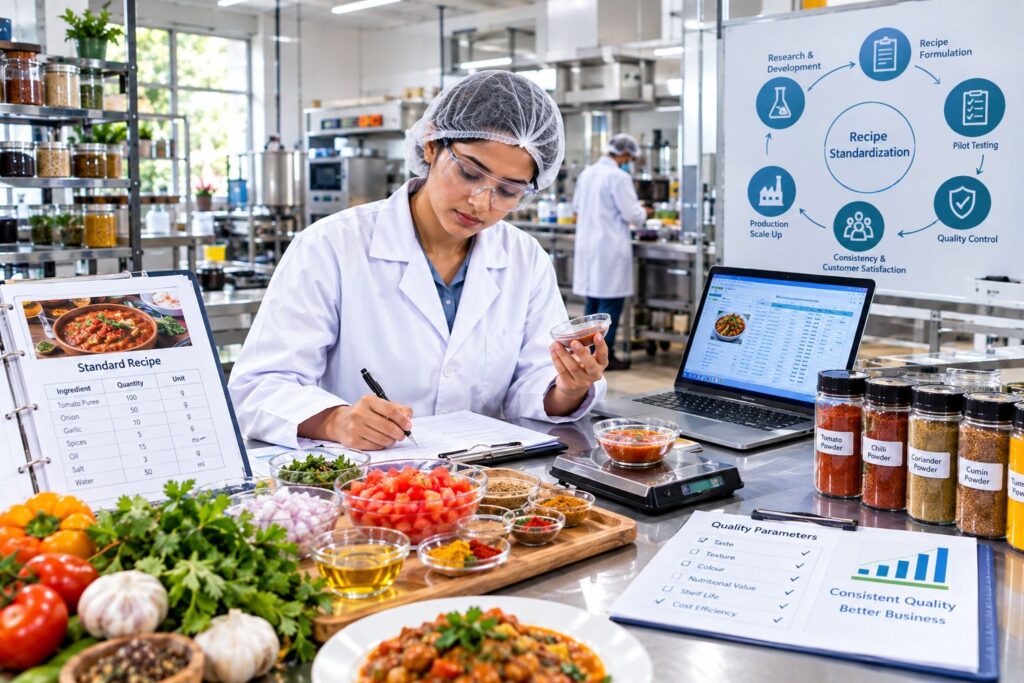
Recipe standardization is vital in the process of taking a home-cooked dish to a marketable commodity. It is more than just simply scaling ingredients; it is about the technical changes needed to include multiple controls and monitors for quality and safety. A professional food consultant and a trained food technologist can assist greatly in the recipe standardization process and the scaling space. These professionals help in creating consistency of flavor, texture, and shelf life while changing the recipe to make it practical for large-scale processes. With expert assistance, food entrepreneurs can achieve what they need a reliable and scalable recipe, and it will meet consumer expectations and market regulations. Introduction It is not as simple as multiplying a home-cooked recipe by a quantity for monetary gain in the ever-changing food industry today. This essential step in recipe standardisation will require technical culinary knowledge, food safety knowledge, and knowledge around scaling up a recipe. This is where the expertise of a professional food consultant comes in. Products developed 0 + Years experience 0 + Countries served 0 + Clients served 0 + Understanding Recipe Standardisation Recipe standardisation is the act of writing, testing and refining a recipe so that the final product is consistent in taste, texture, quality and shelf life no matter where or how it is created. This is an important step for new food entrepreneurs and existing brands before moving into commercial production.A recipe standardisation process involves more than trial and error. It requires elements of creativity and science. Professional food consultants, and food technologists in particular, are specifically trained to identify what makes a recipe perform well in a kitchen and transform it into a commercial, scaled, stable product.The Role of Food Consultants in Recipe Development Recipe development goes beyond just cooking; it is developing a product that is reproducible at scale, while also considering the sensory, nutritional, and safety aspects of the creation. Food consultants work with each client too: Fully develop flavour, texture, and colour through technical knowledge.Identify the best ingredients that will perform successfully through batch production.Respond to dietary and market needs (i.e., gluten free, vegan etc.).Ensure adherence to the relevant food safety regulations. Developing a recipe is an exercise in balancing science and art. When you engage the services of a food technologist, he or she will help ensure that you have created something distinctive – a sauce, a chutney or a premium protein snack – and that it has the capacity to be further developed into a repeated (on a larger-scale) product.Scaling Up Without Compromising Quality For any food entrepreneur, scaling a recipe for commercial production is one of the most difficult stages in the development of a product. Recipes that are scaled up, or double or tripled generally do not work because the interaction of ingredients change significantly at larger volume. For example, spices may react differently on a large scale; and the cooking situation is different on an industrial scale compared to the home stove, where heating may vary considerably. This is where a food consultant or food technologist comes in, making the precise changes in formulation and process. They have a good understanding of the equipment capacities, production flows, and ingredient stability that need to be addressed in the context of keeping the taste and quality consistent with the original recipe when the product is being produced at 100’s of kilograms in size. Scaling also has to do with what production method is processed, i.e., bakery, extrusion, cold processing, hot filling, etc. It is important to select the method correctly based on the recipe and the food consultant will work the brand through pilot trials, shelf-life studies and quality control studies, which are normal parts of scaling a recipe for a product.Ensuring Consistency and Shelf Life Consistency is vital in the food industry. Consumers want the same flavour to experience every time they buy your product! Food consultants document steps, like cooking time, temperature, order of mixing, and the cooling process, which are all necessary for consistent batches. Food consultants also evaluate packaging and storage methods that allow for a longer shelf life which is especially critical for startups and D2C food brands shipping product across regions without some sort of compromise to the sensory or nutritional value of the product. Conclusion Whether you are a budding food entrepreneur, or an existing company launching a product line, recipe development and standardisation is a pursuit that cannot be taken lightly. Without proper expertise, even the best recipe in the world can fail in a commercial environment. Partnering with a professional food consultant, particularly one with a food technologist background gives you a scientific knowledge aspect, a regulatory knowledge aspect, and practical industry knowledge. They can not only assist with making your vision a reality, but they will assist with ensuring the product is scalable, safe, and consistent so it can win consumers’ trust and stand up to the competition. Frequently Asked Questions If I scaled my home recipe myself, would it work?You can try scaling your home recipe by yourself, however, if you don’t hire a professional food consultant/ food technologist you risk scaling it improperly and will have variations in taste, texture and shelf life due to scaling the recipe with different ingredient quantities and processing methods. What does a food consultant do to scale a recipe? A food consultant will take your original recipe and modify it for mass production by changing ingredient proportions or cooking method and taking into account any special equipment constraints you’re limited by, and ensure that when your product scales, it will remain consistent and retain the quality of original recipe. What difficulties might come up when scaling a recipe? Changes in ingredient behavior, cooking times, and product stability are typical problems when scaling recipes. To guarantee efficient and dependable production, a food consultant assists in addressing these issues scientifically. Is it possible for a food consultant to assist with both recipe development and scaling on an industrial scale? Definitely. A food consultant pairs

Food consultant helping beverage startups with product development and commercial production
FFCE

Why Beverage Startups Fail Without a Food Consultant’s Support

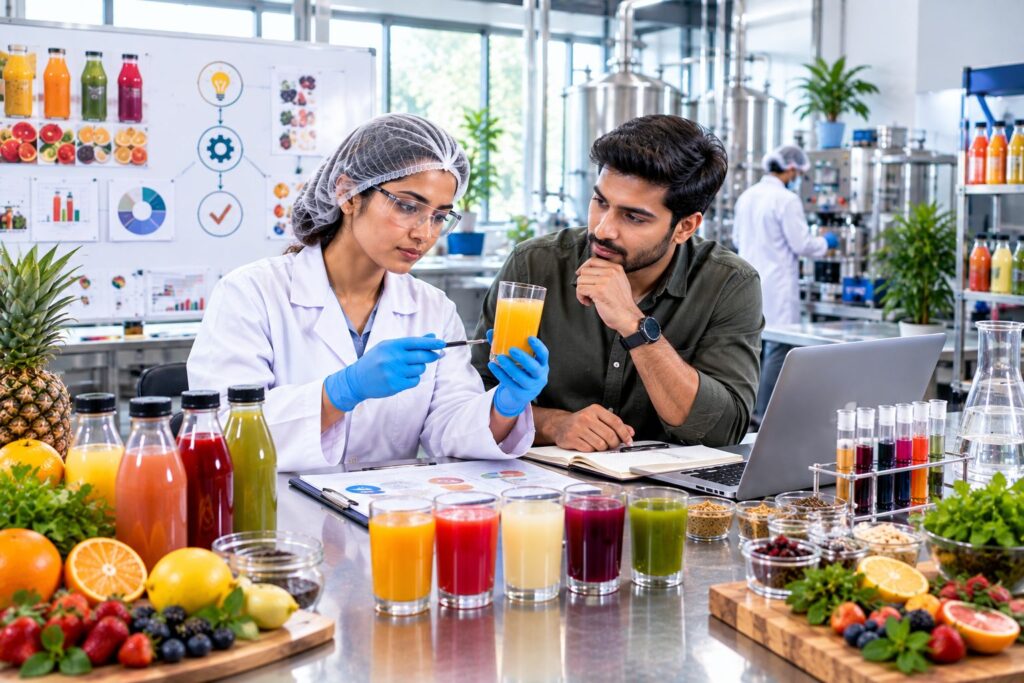
Numerous beverage startups fail, in part, due to the absence of a food consultant or food technologist on their team. Even if beverage entrepreneurs have a great idea to get started, they are often not equipped to address many key technical components of beverage formulation, as well as legally complying with labeling concerns, shelf-life stability, and a plan for scaling production. A food consultant serves as a helpful startup navigation tool, using their expertise to assist with the many factors of product development, securing legal approvals, packaging, and compliance with cold chain requirements. Without accessing a food consultant, most beverage formulation start-ups suffer common problems such as ingredient instability, labelling mistakes, and challenges with scaling production from test batches to full production. To effectively compete in the beverage startup world, consulting the expert food technologist and a food consultant, and their support can be highly beneficial from the onset. Introduction Starting a beverage company is certainly an exciting and fulfilling experience, but it’s also a very competitive and challenging technical environment. Though the harsh realities won’t always be a shock, entrepreneurs frequently enter the field with a lot of passion and an idea that may include a popular ingredient. From beverage formulation to compliance and scaling and everything in-between, the consequences of neglecting professional assistance can mean avoidable blunders. Food consultants and food technologists are professionals who have a wealth of experiences and resources, and entrepreneurs often overlook hiring one or both in the early days of their beverage startup. One of the top reasons beverage start-ups fail is due to not having a food consultant or a food technologist on their team. Products developed 0 + Years experience 0 + Countries served 0 + Clients served 0 + Understanding the Realities of Beverage Formulation The product is the heart of any beverage business. Whether you are making an herbal drink, protein drink, fruit-based drink, or a carbonated health tonic, beverage formulation is not just about taste. The food technologist will ensure that your beverage product is stable and safe and will last on the shelf for a reasonable amount of time.The food technologist will also consider important factors such as, ingredient interactions, pH levels, preservatives, and emulsifiers – all of which influence prevent problems such as separation of ingredients, microbial growth, changes to the product, and spoilage. Many entrepreneurs do not know who or what a food technologist is, and many think they can create a great formula and figure out the process through trial and error, Youtube tutorials or a home recipe. The reality is that beverages created in a home kitchen simply do not translate into commercial production. This gap between idea and execution is where most startups find problems. The Role of a Food Consultant in Startup Success To transform your beverage concept into a workable, marketable product, a food consultant is essential. They do much more than just technical things of beverage formulation. They serve as your startup manual, providing information on supplier networks, equipment, packaging materials, and regulatory compliance. Here are essential areas in which a food technologist or food consultant adds value to a business: Product Development & Recipe Standardization A consultant ensures your beverage’s taste, color, and texture are the same every time a single batch is made by you. A consultant will also help improve the recipe so that it is the most cost effective and can be made in larger quantities. Regulatory Assistance Food Laws such as FSSAI licensing (for India) requirements for nutrition labeling and nutrition claims are very complicated. A food technologist will help you meet these requirements since many beverage formulation start-ups aren’t able to and as a result often lose products to recalls or incur penalties. Shelf-Life Testing An additional reason why beverages fail is due to shelf-life validation. A food consultant will run a series of microbial and chemical testing to validate the intended use of the product over its intended life. Pilot Trials and Scaling Up Successfully taking a batch, which may be only 1-litre to 1,000 litres in a capacity commercial operation, means that the product may be changed in taste, stability, and yield potential. A food technologist should help you perform pilot trials, make modifications to the production process as necessary for mass production. A Startup Guide to Packaging and Cold Chain Advice Proper packaging and cold chain planning are essential components of a successful beverage startup guide. Without it, goods could lose their flavor, deteriorate, or leak. A food consultant can help select appropriate packaging materials and design a cold chain system suited for temperature-sensitive drinks. Frequent Mistakes When Startups Go Alone Beverage Startups will make expensive mistakes without the support of a professional food consultant: Assuming your manual production is the same for production on a large scale These types of issues will cause your product to fail, result in consumer complaints or force a regulatory body to shut down your product. Why Good Taste is Not Enough? Although good taste is important, Great beverage startups do not just innovate the product with flavour. The beverage must be scientifically designed, legal matters addressed, and technically reproducible. A food technologist will help ensure that your vision ticks every box. Not even premium packaging or best-practice marketing pays off when a product is poorly formulated or unstable. A single bad batch may destroy your brand reputation forever. Conclusion For any entrepreneur that is entering into the beverage space, food consultation is not an option – it is a requirement. They have the knowledge for beverage formulation, regulatory aspects, and scaling up production so they’d be more able to wholly develop a creative idea into a full-blown brand, allowing you to commercialize it effectively. Essentially, a food technologist allows you to be the startup. It also saves you costly mistakes that obscured beverage entrepreneurs have made before you and allows for faster access to a market.If you care about launching a beverage that is unique and sustains interest in a heavily loaded

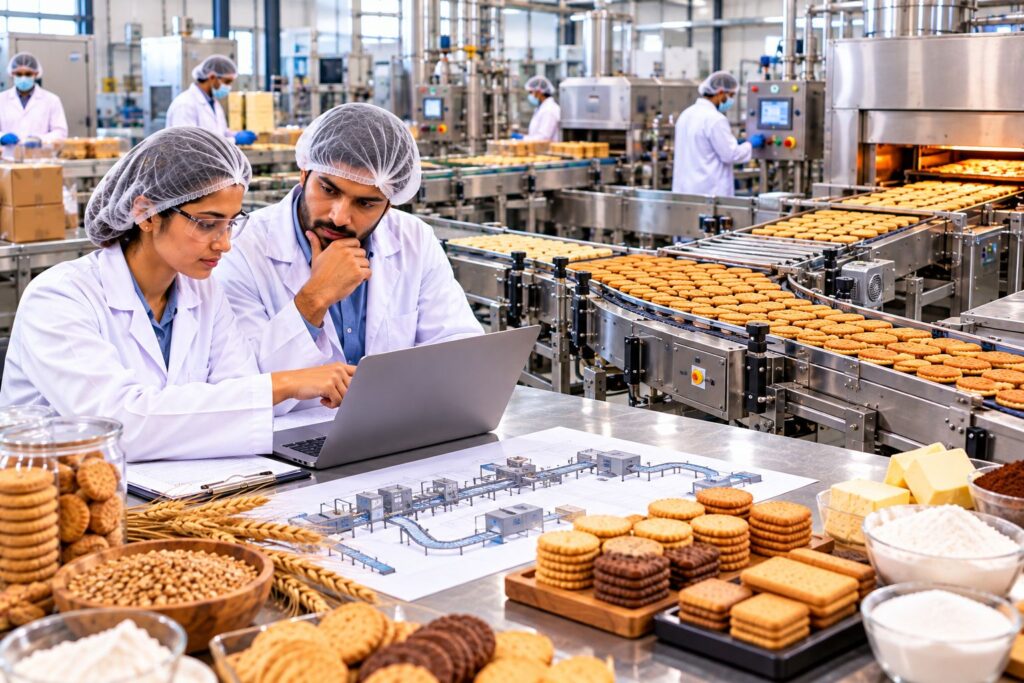
Biscuit production line with factory layout and commercial manufacturing equipment
FFCE

Cost and Layout of Biscuit Production Line — A Food Consultant’s Guide

When starting a biscuit setup, the investment costs, and plant design must be carefully considered. A biscuit setup will have all the essential unit operations involved in production from dough preparation, forming, baking, cooling and packaging and with a good layout and service planning, the operations can be kept clean and efficient. The costs for setting up a semi-automatic unit can range from ₹60 lakhs to ₹1.2 crore depending upon the level of automation and the capacity of the unit. You will need a food technologist for developing recipes, standardizing processes and ensuring product consistency, etc. Entering the biscuit industry with a practical ability to procure appropriate machinery, develop procedures and comply with FSSAI regulations will be made simpler with the advice of a food consultant. Introduction The biscuit industry in India has experienced impressive growth due to a variety of factors such as increased urbanization, changes in consumer preferences, and growing demand for packaged snacks. If you have considered joining this sector by setting up an industrial biscuit plant, this can be a profitable opportunity for you with two major prerequisites: economical biscuit setting up and an intelligent plant design. At this point a knowledgeable food technologist and a food consultant will play an important role. Products developed 0 + Years experience 0 + Countries served 0 + Clients served 0 + Understanding the Biscuit Setup From preparing the dough to baking, cooling, and packaging, a standard biscuit production line has several integrated sections. Every section needs to be in line with capacity and energy efficiency in addition to flow. A typical sequence for the procedure to manufacture biscuits: Dough Preparation: This involves mixing the flour, fat, sugar and other ingredients. Dough Feeding: The mixed dough is fed to sheeters or moulders as required. Forming Section: The dough will then be sheeted, laminated or rotary moulded as required into shape. Baking Oven: The formed biscuits will be baked in gas or electric ovens. Cooling Conveyor: The baked biscuits will cool to room temperature. Packaging Line: The biscuits will be packed using automatic machines for retail distribution. A food technologist is useful in recipe standardisation since it ensures that each stage operates consistently and efficiently. Plant Design — The Heart of Efficient Production A well-designed plant layout minimizes the need for labor and material handling times; provides improved production efficiency and cleanliness; and is often recommended as a U-Shaped or linear layout (depending on space and production capability). Key considerations in plant design include: Important considerations in plant design include: Segregated Areas: Separate areas for raw material storage, processing, baking and packaging Workflow: Avoiding cross-contamination with unidirectional workflow Air and Water Flow: Proper air handling system and plan for water drainage Utilities: Provide adequacy for electrical power, gas lines, compressed air, and water. A food consultant makes sure the plant design is scalable for future growth and complies with FSSAI and GMP regulations. Role of a Food Technologist in Biscuit Manufacturing Involved in recipe development to process optimization, a food technologist provides a significant role in: Selecting the right ingredient and formulations Selecting proper machinery and process conditions Warranty shelf-life stability and food safety compliance Training staff with respect to quality control and hygiene Food technologists also assist in the development of variants such as digestives, cream-filled biscuits, and cookies with nutritious ingredients. Why You Need a Food Consultant A food consultant does not just bring knowledge of the industry; it also ensures that you avoid costly mistakes. Their contributions include: Making market research and feasibility studies Selecting vendors to supply machinery and ingredients Layout planning with hourly architect Obtaining licenses and approvals from regulatory bodies such as FSSAI and your factory license Conclusion Establishing a biscuit plant is much more than investing in equipment. It involves proper planning of the plant layout, knowing your costs, and having technical skills. Using a food technologist and a food consultant will give you confidence that you are in line with the industry standard while also optimizing the performance and quality of your biscuits. If you are considering entering the biscuit industry, make sure you seek expert professional support as soon as possible. The biscuit industry is growing, so having an informed food consultant help you plan a biscuit plant designed by food professionals puts you on the right track to long-term growth. Frequently Asked Questions 1. What is a small biscuit setup’s appropriate production capacity? A small biscuit setup is typically in the range of 250 to 500 kg/day and would be appropriate for anyone starting up in the industry with limited capital utilization, resources, and/or space. 2. What are the major processes in a biscuit setup? A biscuit setup would have broadly dough making, forming, baking, cooling, and packaging. All of these processes would typically be incorporated in a plant layout that is linear or U-shaped normally for best efficiency. 3. What is the role of food technologist in biscuit production?A food technologist has expertise in recipe formulation, standardization of processes and quality control, as well as, of course, food safety and testing. The quality would refer to the taste, texture, and consistency of product made. Food safety refers to governing bodies like the FDA, that basically ensure safe food products are being packaged and distributed for sale.

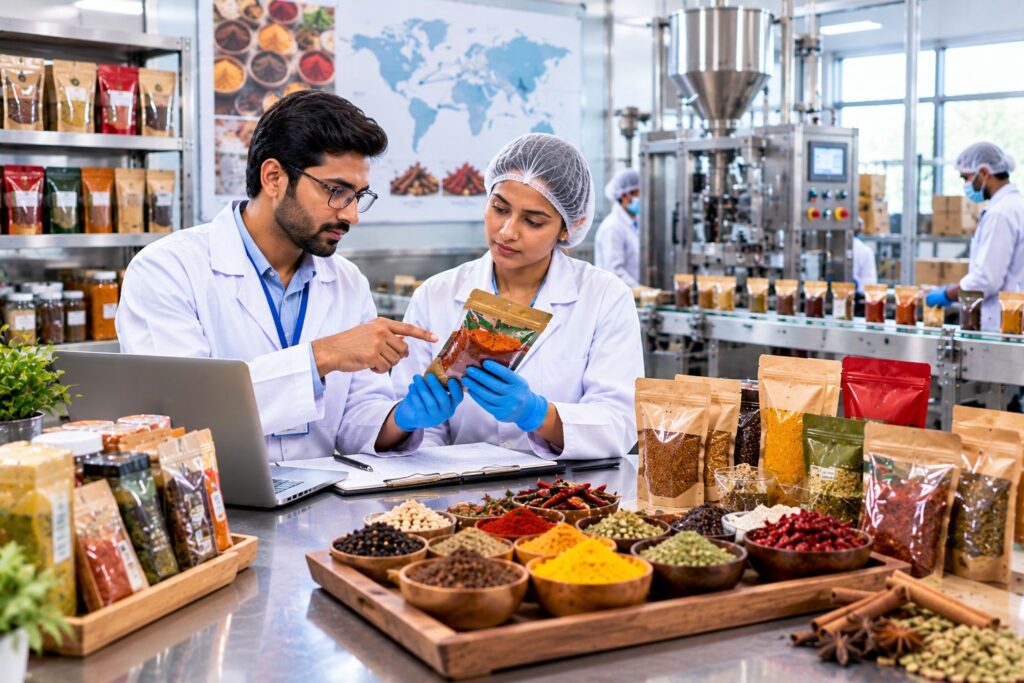
Spice packaging process with modern packaging materials and food manufacturing equipment
FFCE

How a Food Consultant Helps You Choose the Right Packaging for Spices

Choosing the appropriate spice packaging requires careful consideration of market objectives, product sensitivity, and FSSAI compliance. This is where a food consultant comes in. They make sure packaging maintains freshness, improves shelf appeal, improves logistical issues and complements your brand strategy in close collaboration with a food technologist. The secret to a profitable spice business is this expert-led strategy. Introduction In India, classical ingredients and genuine recipes would never suffice for a spice brand. It must be rightly packaged to preserve aroma, maintain shelf stability, comply with regulations, and attain aesthetic shelf appeal. Therefore, a food consultant or the food technologist would fit perfectly in this space. Such consultants would assist you in facing the spice packaging difficulties with a mixture of market knowledge and technical skills. Products developed 0 + Years experience 0 + Countries served 0 + Clients served 0 + Why Packaging Matters in the Spice Business Spices are delicate substances prone to environmental damages caused by moisture, light, oxygen, and temperature. If bad spice packaging is used, it can lose its aroma, flavor can be degraded, clumping can take place or contamination via microorganism growth can occur. Proper spice packaging increases the commercial shelf-life of the spices and augments consumer trust and satisfaction of all regulatory provisions. Spice Packaging is the first interaction with the customer; it should therefore speak quality, hygiene, and authenticity. Role of a Food Consultant in Packaging Strategy Whether you’re targeting local kirana shops, supermarkets, or exports, a qualified food consultant can offer extensive industry experience in determining what spices work best for your business objectives. 1. Understanding Product Sensitivity Every spice has its specific reactions. For instance, salt easily attracts moisture, while turmeric is sensitive to light. A food consultant defines the spice blends used together with the food technologists and suggests suitable containers like PET jars, glass bottles, or pouches with several layers. 2. Recommending Packaging Materials A food consultant advises on choice among: • PET or HDPE jars: Best for powdered spices which need great barrier protection. • Glass bottles: Setting premium appeal with non-reactiveness to gourmet-type spice blends. • Metalized pouches: With minimum weight and cost as the best option for refills. • Zip-lock laminates: Great for resealing convenience by consumers. 3. FSSAI and Labelling Compliance In India, food product packaging comes under the jurisdiction of the FSSAI. Food Consultant helps your spice packaging to carry mandatory declarations for net weight, batch number, date of packaging, best before date, nutritional value, and allergen information. They may even help you organize the different elements of label design as per font sizes and positioning laid down under law. 4. Sustainability and Consumer Appeal With such growing consumer awareness, many brands continue towards sustainable spice packaging. The food technologist, along with your food consultant, would then recommend using biodegradable, recyclable, or reusable materials for packaging consistent with an eco-conscious brand image. They further recommend packaging shapes, colors, and closures that enhance shelf visibility and serve ease of use. 5. Evaluating Storage and Supply Chain Needs Your spice packaging must endure the transport conditions of humidity, temperature, pressure from stacking, and others, especially if your intention is exporting or distributing to various parts of India. A food consultant evaluates storage, transit, and warehousing conditions before suggesting the type of packaging and thickness thereof. 6. Testing and Validation Upon choosing the packaging, the food consultant will liaise with the testing laboratories to enliven good scientific barrier tests, leak tests, shelf-stability tests, and migration tests. These scientific tests, often controlled by a food technologist, forestall any recalls but, basically, secure the product. Conclusion The selection of appropriate spice packaging requires individualized assessment instead of using standardized methods. Food consultants and food technologists bring major value because they combine technical knowledge with brand positioning expertise. Their professional knowledge provides genuine business value through compliance assurance, freshness maintenance, enhanced consumer appeal and storage durability. The early involvement of experts benefits businesses by reducing expenses while shortening timelines and building trust when entering local or international markets. Frequently Asked Questions 1. What information should be required on spice packaging in India? Product name, list of ingredients, the FSSAI license number, net weight, MRP, batch code, packaging and best-before dates as well as manufacturer information are the required on spice package. 2. Do I need different packaging for domestic and export markets? Yes. A food consultant will work with you to modify your spice packaging according to the import regulations and climatic conditions and consumer tastes of the destination country while a food technologist provides technical compliance support. 3. What are the most cost-effective packaging options for spices? Flexible pouches combined with zip-lock laminates provide affordable scalable packaging solutions and a food consultant can help select the best cost-effective compliant packaging option for your spice brand. 4. What impact does packaging have on FSSAI compliance? The FSSAI requires tamper-proof sealing, material safety, and unambiguous labeling. To avoid fines, a food consultant makes sure your spice packaging complies with all legal and labeling requirements. 5. How can packaging help my spice brand get more attention in the market? Strategic spice packaging design together with functional aspects enhances product visibility on shelves and creates better user convenience and builds consumer confidence. A food consultant will work with you to match your packaging design with your brand objectives.

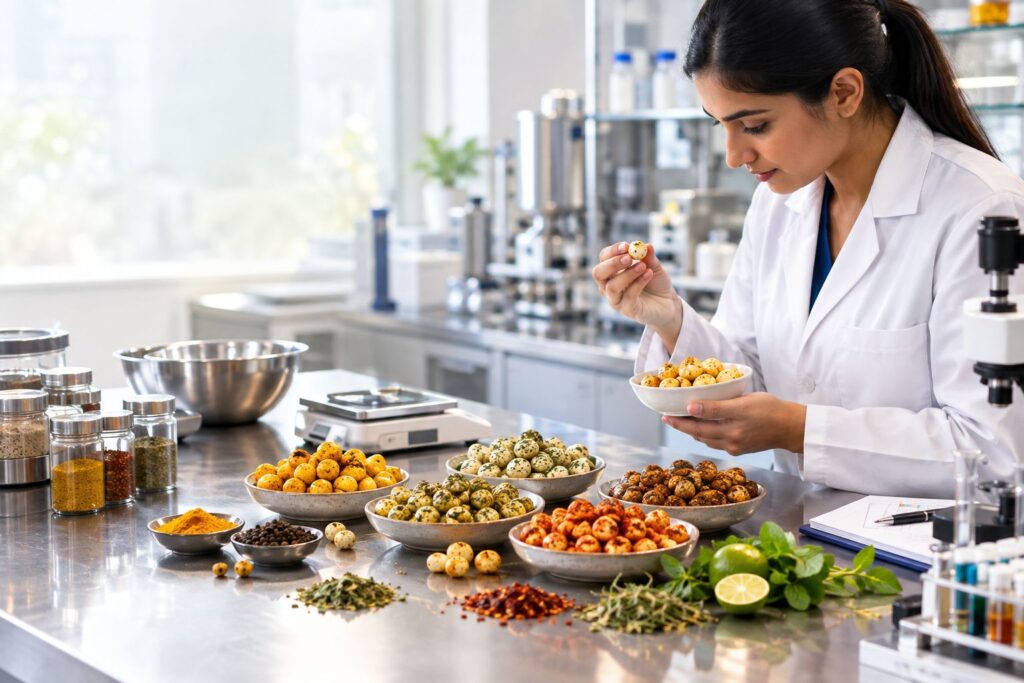
Makhana flavor innovation with different seasonings and food product development
FFCE

The Role of a Food Technologist in Makhana Flavor Innovation

A food technologist is essential in creating innovative makhana flavors by fusing consumer insights with food science. They propel effective snack innovation by guaranteeing flavor stability and assisting with clean-label objectives. Their skill makes makhana delicious and nutritious, making it ideal for today’s snackers. Introduction Makhana or lotus seeds have gone from being a traditional Indian snack food to being a superfood super-hit across the globe in the course of just a few years. Makhana has gained popularity among health-conscious consumers since it is low-calorie and high-protein. But most importantly, what actually makes it a superstar in today’s snacking segment is the delightful variety of makhana flavors to appeal to different tastes. The power is in the skill of the food technologist-the driving force in creating attractive, shelf-stable, and scale-able snack breakthroughs. Products developed 0 + Years experience 0 + Countries served 0 + Clients served 0 + Understanding the Makhana Market The rise of makhana in the health snack category has provoked numerous startups along with FMCG companies to play around with flavor profiles. Consumers no longer settle for simple roasted makhana. They want new taste experiences similar to potato chips or popcorn but better for their health. Food technologists come into action there, striking a balance between health benefit and flavor addition and turning makhana into a pick consumers cannot help but make. The Science Behind Creating New Flavors New flavors of makhana are not simply adding spices. It is a science based on food chemistry, flavor carriers, natural ingredients, and palatability preferences. Food technologists are able to use sensory evaluation, ingredient compatibilities, and food safety standards to develop a snack product that is flavourful, and stable long term. For example, if it is planned to introduce salt and pepper flavored makhana, the food technologist should make the spice mixture meet FSSAI standards, keep it palatable throughout the whole shelf life of the product, and have good binding capacity with roasted seed without changing texture. They can attain the best through processes such as oil coating, flavor encapsulation, or dry roasting under temperature control. Balancing Health and Taste Health-aware customers anticipate their snack innovations to be artificial additive-free, preservative-free, and low in sodium. The challenge for food technologist is to keep the taste intact while fulfilling these anticipations. That would involve sourcing natural flavor ingredients, employing cold-press oils, or value addition in terms of nutritional additions such as protein seasoning or herbal essences. Turmeric and black pepper enriched makhana can add flavor and health worth. An effective food technologist enables the bioavailability of all ingredients and ensures the texture or mouthfeel is not compromised of the snack. Consistency and Scalability Consistency is one of the largest challenges in flavor innovation, recreating every packet of makhana to taste exactly the same. It is done through standardized recipes developed by a food scientist, batch procedures laid down, and coordinating with manufacturers to ensure evenness of flavor distribution in high volumes. They also check for moisture content, packaging compatibility, and shelf stability—important parameters of commercial snack development. For instance, if the flavoring is moisture-sensitive, then the makhana would become soggy. The food technologist would then recommend nitrogen flushing in packs or silica sachets to preserve crispness. Collaborating with Marketing and R&D Flavor innovation is not an isolated activity. A food technologist typically teams with marketing departments to explore future flavor trends, pilot limited time or seasonal makhana flavor concepts, conduct consumer trials, and receive and incorporate feedback into finished recipes before launches. Food technologists also document the product development journey for FSSAI audits and can assist the R&D team in a breadth of innovations such as providing gluten-free coatings, low GI ingredients or plant-based flavorings for specialty or niche markets. Conclusion The uniqueness of makhana flavors—from smoky barbeque to mint-lime lush—can be largely attributed to the scientific, creative, and regulatory knowledge of a food technologist. As the increase of healthy snacking continues, the food technologist’s role in snack innovation is equally on-the-rise. They guarantee all the flavor in every bite of makhana is safe, scalable, and satisfying. Frequently Asked Questions How much time does it usually take to develop a new flavor of makhana? It may take a few weeks to months, depending on the flavors. At present, companies focus on testing flavors that includes testing seasoning blends, base-level macro and micro adjustments and testing packages during the snack innovation phase. Are all makhana flavors made with natural ingredients? Many brands are responding to market consumer demand by focusing on clean-label snack innovation. Food technologists use natural flavors during flavor development and avoid artificial additive ingredients. How does snack innovation help with making makhana popular? Mistakes of new healthy food startups can include not following FSSAI guidelines, improper shelf life and changes in flavour. A food consultant can help avoid those mistakes during your training / startup setup. How are new makhana flavors developed? New flavors are developed through the process of snack innovation where we try different seasoning blends, use natural ingredients and test the seasoning conditions from a process point of view as well. Why is a food technologist so important for companies developing makhana? The food technologist is key for flavor development, quality control and ensuring the final product gives the consumer a snack knowledge experience where they deem it safe, tastes good and they’ve made a nutritious choice.

Scroll to Top

Your Trusted Food-Tech Partner Simplifying Solutions, Maximising Success

    Your idea is 100% protected by our Non Disclosure Agreement

    What is Refresh icon

    Your Trusted Food-Tech Partner Simplifying Solutions, Maximising Success

      Your idea is 100% protected by our Non Disclosure Agreement

      What is Refresh icon

      Your Trusted Food-Tech Partner Simplifying Solutions, Maximising Success

        Your idea is 100% protected by our Non Disclosure Agreement

        What is Refresh icon

        Powering your food business forward