
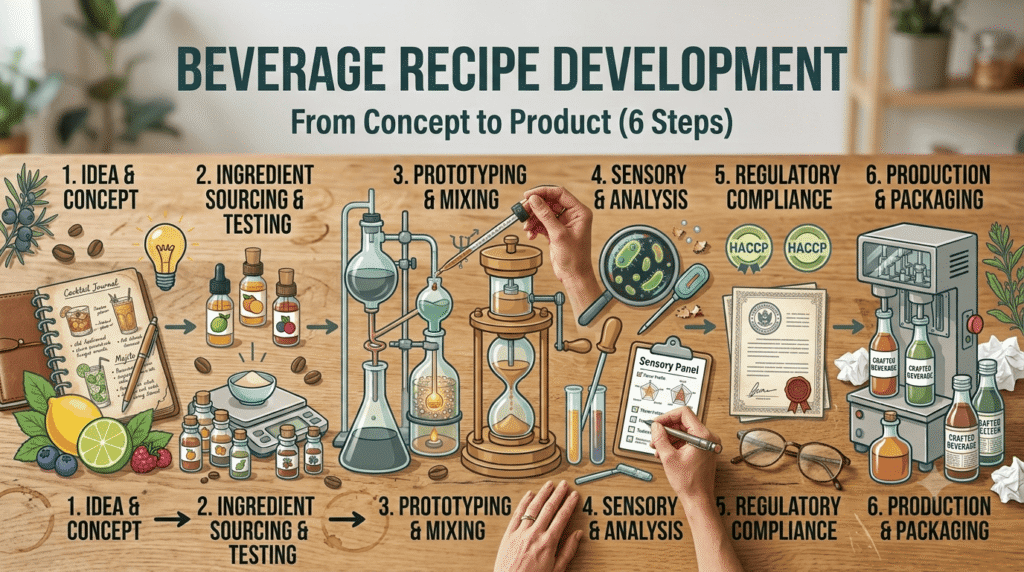
Beverage Recipe Development: How to Create a Commercially Successful Drink
Beverage recipe development is the process of turning a drink idea into a working, commercially viable prototype. Most beverage businesses jump straight to manufacturing without completing a structured beverage recipe development process — and it is exactly why so many drink launches fail at shelf. Before you can formulate a drink for production, you need a recipe that actually works. That is what professional beverage recipe development services deliver: a tested, sensory-validated recipe that can survive commercial scale-up without expensive mid-project reformulation. This guide walks through the complete beverage recipe development journey — from concept to approved prototype. Products developed 0 + Years experience 0 + Countries served 0 + Clients served 0 + What Is Beverage Recipe Development and Why Is It Important? Beverage recipe development is the process of creating a working drink formulation from a product concept — defining what goes into the drink, in what proportions, and achieving a sensory outcome (taste, colour, aroma, mouthfeel) that meets both consumer expectations and commercial production requirements. It is the creative and technical phase that happens before commercial formulation. A recipe is not yet a formula. A recipe defines what you want the drink to be. A formula defines how to make it at scale, under process conditions, with shelf-stable ingredients, at target cost. Recipe development answers the questions: What does this drink taste like? What is in it? Does it work sensory? Is it buildable? Beverage recipe formulation — which is a different and later stage — answers: Can we make this consistently at commercial volume? What are the process parameters? What is the declared shelf life? The distinction matters because rushing from concept to formula without proper recipe development produces products that fail sensory testing, require expensive reformulation mid-project, or reach retail with a taste profile that misses the target market entirely. In practice: Beverage recipe development typically requires 4–12 prototype iterations before a recipe is ready to proceed to the beverage formulation process. Brands that skip this stage almost always revisit it — expensively — after production trials. Aspect Beverage Recipe Development Beverage Formulation Stage Concept → working prototype Prototype → manufacturable specification Goal Create a drink that tastes right Create a formula that can be made at scale Environment Kitchen / bench-scale lab Pilot plant / manufacturing scale Key outputs Working recipe, sensory benchmarks Manufacturing spec, process parameters, shelf life data Ingredients used May include fresh/perishable ingredients Commercial shelf-stable equivalents Shelf life focus Not primary concern Central technical requirement Cost focus Getting the taste right Bill of materials at target COG Regulatory output None at this stage Nutrition facts, ingredient declarations Who leads it Food technologist + sensory team Food technologist + process engineer What comes next Formulation begins Pilot trials, stability testing Step-by-Step Beverage Recipe Development Process There is no single formula for developing a beverage recipe — but there is a logical sequence of decisions that separates structured development from expensive guesswork. Here is the process FFCE’s beverage R&D team follows across all beverage product development projects. Define the Product Concept Before a single ingredient is selected, the concept must be clearly defined: What type of drink is this? What consumer occasion does it serve? What is the brand positioning — premium, functional, natural, nostalgic, indulgent? A poorly defined concept produces a directionless recipe. Spend time here. Every decision downstream flows from this definition. Define the Target Consumer The consumer drives sensory expectations. An energy drink targeting 18–25 year old male fitness consumers requires a very different flavour profile, sweetness level, and mouthfeel than a wellness herbal beverage targeting 35–50 year old female health consumers. Sweetness tolerance, acidity preference, and flavour familiarity all vary significantly across demographics. Define your consumer before you define your recipe. Select the Beverage Category The category determines the technical framework: pH targets, Brix range, carbonation level, packaging format, and preservation system. A carbonated soft drink, a functional RTD, and a plant-based milk all require fundamentally different recipe architectures. Selecting the category is not just a marketing decision — it is a technical starting point. Select Base Ingredients Water quality is the foundation. Hard water affects taste, soft water affects mouthfeel. Most beverage recipes require treated or RO-purified water with controlled mineral content. After water: your primary base — juice, tea extract, dairy, plant milk, or plain water for carbonates. The base determines everything that follows. Sweetener Selection and Brix Targeting Sweetness is the most technically nuanced decision in structured beverage R&D. Sucrose gives clean sweetness with a fast onset. HFCS gives sweetness with a slight delay. Steviol glycosides give intense sweetness with a lingering aftertaste that must be masked. Erythritol gives cooling mouthfeel. Each sweetener behaves differently across pH, temperature, and processing conditions. Target Brix based on category benchmarks, then select sweetener system to achieve it. Acid Balance and pH Acidulants do three things in a beverage recipe: they adjust pH for microbial safety, they contribute to flavour perception (tartness), and they modulate sweetness. Citric acid is the most common. Malic acid gives a softer, more fruit-like tartness that lingers pleasantly. Phosphoric acid is used in colas. The ratio of sweetness to acidity — sometimes expressed as Brix:acid ratio — is what determines whether a drink tastes balanced or cloyingly sweet or harshly sour. Getting this ratio right takes several prototype iterations. Flavour System Development Flavour selection for a beverage is not picking a flavour compound from a supplier catalogue. It is selecting a primary flavour, a top note, a middle note, and sometimes a masking agent — then testing how each interacts with your base, sweetener, and acid system at the target pH and temperature. Flavour performance changes significantly between ambient and chilled, between carbonated and still. Benchmark against 2–3 competitor products. Know what you are matching and where you are differentiating. Mouthfeel Engineering Mouthfeel is the most underestimated element of developing a beverage recipe. Consumers describe mouthfeel as “thin,” “watery,” “thick,” “creamy,” “smooth,” or “heavy” — and it is driven by viscosity, dissolved solids, carbonation level, and fat content. In zero-sugar beverages,
